“It is not the full complete Bible. It only has the 22 books. It does not contain the 66 books of the Holy Bible that Christians use today.”
Naomi, verified purchase, July 20268 of 10
Red flags raised
Checked 24 August 2026
- ✗ The book count is not an Ethiopian count
- ✗ The page count cannot hold the text
- ✗ Digital vault or bonus padding
- ✗ No Books of Church Order
- ✗ 1 Clement in place of Qalementos
- ✗ The formatting is a wall of text
- ✓ Stock photo or AI generated portrait
- ✓ Claims scholarship, gets the canon wrong
- ✗ No source attribution
- ✗ Old Testament from the wrong base text
Each row is one entry from our checklist for spotting a fake Ethiopian Bible, which explains how to run every test yourself. Our own edition scores 0 of 10 on the same ten points.
"The Complete Ethiopian Bible in English (Extra-Large Print 17-Point Font, Illustrated)" is published by Solomon's Gate Press. It appeared on Amazon on 2 November 2025. It sells for $48.99 in paperback and $53.99 in hardcover, and on the day we reviewed it, 6 August 2026, it ranked #1,941 in all of Books.
It is 530 pages. Its table of contents lists 22 texts. One of them appears in an ordinary Bible.
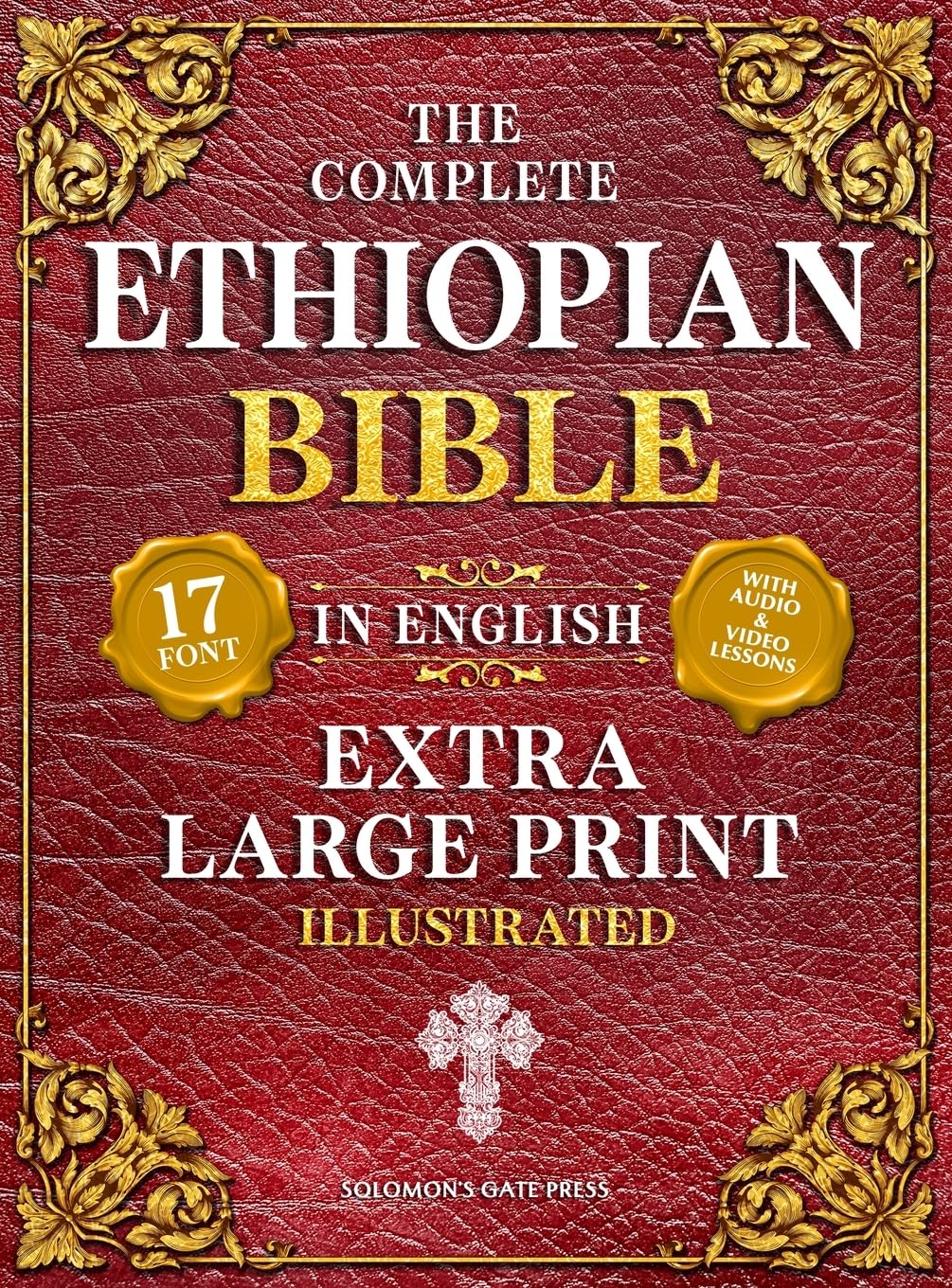
The Word on the Cover
Most editions in this category lead with a number. This one leads with a word: COMPLETE, set in the largest type on the jacket above the title itself.
The Ethiopian Orthodox Tewahedo Church counts its canon at 81 books, 46 in the Old Testament and 35 in the New. That comes to roughly 1.2 million words. Our own edition of it measures over 1.2 million, counted from the manuscript with headings and markup stripped.
So "complete" is not a matter of taste here. It is a quantity, and quantities can be checked.
The Math
A book holds its page count multiplied by its words per page. Words per page is governed by trim size, type size, and column count. This edition is 8.49 by 11.24 inches, which is very nearly the page area of our own A4 edition, so the comparison is unusually direct.
We get more than 1,600 words onto a page at 8-point type in three columns. That is measured, not estimated, and it is dense to the edge of what we were willing to print. At 17-point type, on the same page area, you would expect something in the region of 350 words per page with normal paragraphing.
Ethiopian canon: ~1,200,000 words
530 pages at 17-point type: ~185,000 words
To print the canon at this type size would take roughly 3,400 pages.
There is also a ceiling. Amazon KDP will not manufacture a paperback much past 828 pages, depending on trim and paper. Our edition needed A4 pages, three columns, and a drop from 8.5-point to 8-point type to land underneath it. That is the actual cost of printing this canon once, in one volume, and it is why nobody else has done it.
A single-volume, extra-large-print, illustrated complete Ethiopian Bible is not a book that was badly made. It is a book that cannot be manufactured.
The Table of Contents
We opened the free Amazon preview.
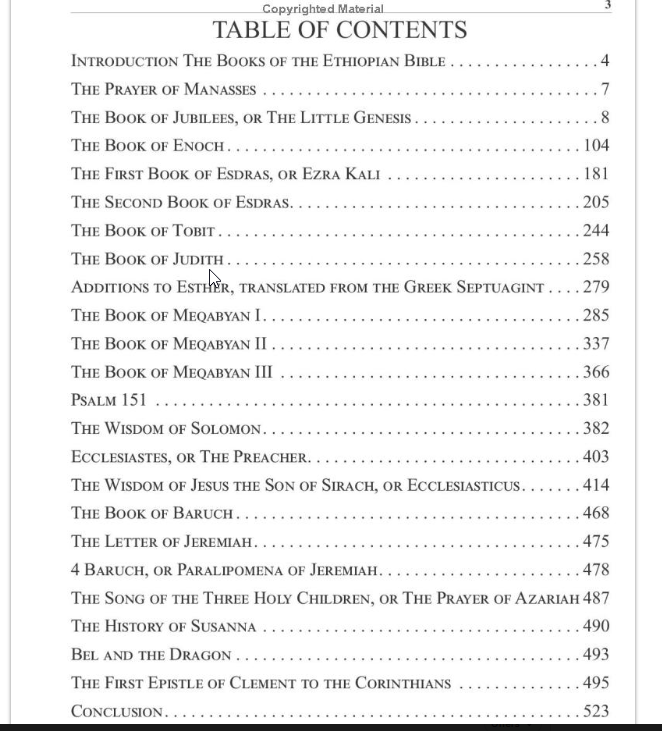
Read the whole list, because the whole list is the point. Prayer of Manasses. Jubilees. Enoch. First and Second Esdras. Tobit. Judith. Additions to Esther. Meqabyan I, II and III. Psalm 151. Wisdom of Solomon. Ecclesiastes. Sirach. Baruch. Letter of Jeremiah. 4 Baruch. Song of the Three Holy Children. History of Susanna. Bel and the Dragon. First Epistle of Clement to the Corinthians.
That is the book. Twenty-two texts.
There is no Genesis. No Exodus, Leviticus, Numbers or Deuteronomy. No Joshua, Judges, Samuel, Kings or Chronicles. No Psalter, apart from the single orphan Psalm 151. No Proverbs. No Isaiah, no Jeremiah, no Ezekiel. No Daniel. None of the twelve minor prophets.
And no New Testament. No Matthew, Mark, Luke or John. No Acts, no letters of Paul, no Revelation. Of the 35 books the Ethiopian Church counts in its New Testament, this volume contains none.
Ecclesiastes is the sole book here that a reader would find in an ordinary Bible. One out of twenty-two.
Where the Contents Came From
Look at the titles rather than the books. "The Prayer of Manasses." "The First Book of Esdras." "The Song of the Three Holy Children." "The History of Susanna." "Bel and the Dragon."
Those are the section titles of the King James Apocrypha, in the King James order, with the King James spellings. The Ethiopian tradition does not name its books that way.
One detail settles it. The three Greek additions to Daniel are all here: the Song of the Three Holy Children, Susanna, and Bel and the Dragon. Daniel is not. Those three texts exist to sit inside Daniel, and every tradition that keeps them prints them there. Catholic and Ethiopian Bibles both place Susanna and Bel as chapters 13 and 14. They only ever appear free-standing, in this order, under these titles, in one place: the appendix of a Protestant Bible, where they were put after being removed from Daniel.
A book assembled from an Ethiopian source could not produce this table of contents. A book assembled from a King James Apocrypha, with Enoch, Jubilees and the three Meqabyan added, produces it exactly.
What Is Missing
Here is what the Ethiopian canon requires beyond the familiar books, and what this edition contains:
| Required Book | Present? |
|---|---|
| Sirate Tsion (Order of Zion) | Missing |
| Te'ezaz (Commandment) | Missing |
| Abtilis (Statutes of the Apostles) | Missing |
| Gitzew (Apostolic Canons) | Missing |
| Didascalia | Missing |
| Mashafa Kidan I and II (Book of the Covenant) | Missing |
| Qalementos (Ethiopic Clement) | Missing |
| Josippon (Zena Ayhud) | Missing |
| The four Gospels | Missing |
| The Octateuch (Genesis through Ruth) | Missing |
The volume does contain "The First Epistle of Clement to the Corinthians," which is a genuine early Christian letter and is not Qalementos. Qalementos is a separate Ethiopic work in several books, surviving in Ge'ez, translated into French by Grébaut across eight volumes of the Revue de l'Orient Chrétien between 1911 and 1928. The two are related only by the name Clement. Substituting one for the other is the most common error in this category, and it is the clearest sign that nobody consulted an Ethiopian source at any stage.
The 17-Point Font
The type size is real. It is also the reason the book fails on its own terms.
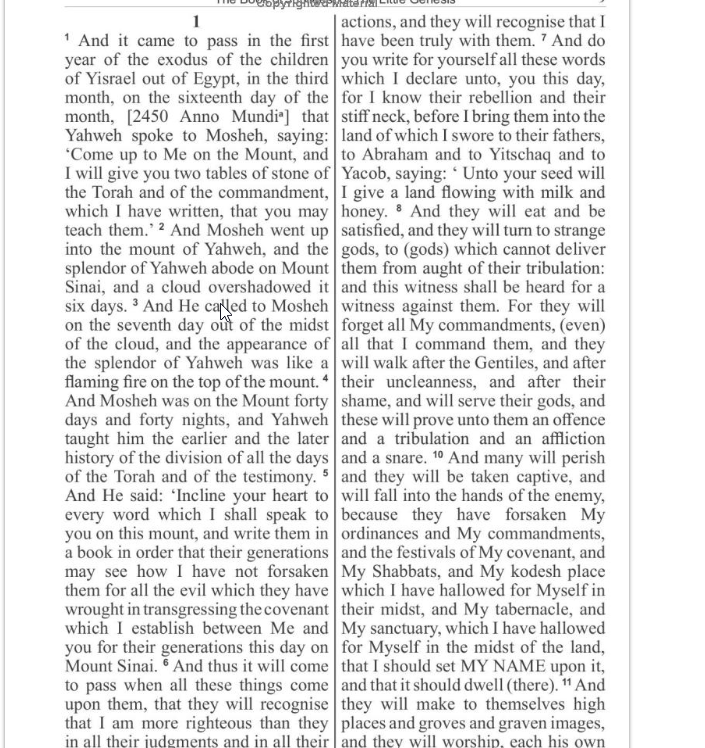
Large print exists so that people who struggle to read can read. It is an accessibility feature. What arrives here is 17-point type set in two justified columns with no paragraph breaks at all, verse numbers run inline, the text continuing as an unbroken wall from the top of the column to the bottom of the page.
Every piece of whitespace that helps an eye find its place again has been removed. That is how a book set in large type still manages roughly 540 words per page. The type was enlarged and the formatting that makes large type useful was left out, which produces a book that is harder to read than a normal one, at 530 pages and $48.99.
One further note on the text itself. It renders the divine name as "Yahweh" and personal names as "Mosheh," "Yisrael," "Yitschaq" and "Yacob."
We should be straight about our own position before making anything of that, because we are not working from Ge'ez either. Our Old Testament rests on Brenton's Septuagint, and our Enoch and Jubilees on R.H. Charles. We say so on every page where it matters, and our names follow those sources: Moses, Israel, Isaac, Jacob, with the Greek forms showing through in places, as they do in the Ethiopian tradition itself.
That is the distinction worth drawing. The early Ge'ez Old Testament was translated primarily from Greek, so Greek-derived names sit inside the same line of descent the Ethiopian text came down. "Yahweh" and "Mosheh" sit inside a different one entirely: a twentieth-century Sacred Name convention out of Western Hebrew Roots publishing. It matches neither the Ge'ez nor the Greek. It is a house style borrowed from somewhere else and applied to Charles' translation of Jubilees, which is the same tell as the King James contents list, showing up in the prose instead of the table.
The Buyers Already Know
Every review below is a verified purchase. We have quoted them as written.
★★★★★
"This particular book is NOT a complete version of the Biblical record. It was said it was 88 books, but .. The only New Testament record is of ' The First Epistle of Clement to the Corinthians' There is not much concerning the life of JESUS and his walk here, much less the 4 books."
William Brandt, Verified Purchase, May 2026 (11 people found this helpful)
A buyer with no access to a table of contents worked out exactly what we worked out from one: the only New Testament text in the book is 1 Clement.
★★★★★
"Very disappointed. It is not the full complete Bible. It only has the 22 books (one being chapters that were taken out of Ester). It does not contain the 66 books of the Holy Bible that Christians use today."
Naomi, Verified Purchase, July 2026 (6 people found this helpful)
Twenty-two. She counted them too.
★★★★★
"The title is "The Complete Ethiopean Bible", but this is not true, as it only contains 22 apocryphal books, which are commonly available elsewhere..."
Amazon Customer, Verified Purchase, May 2026 (24 people found this helpful)
★★★★★
"This is NOT a "COMPLETE" Ethiopian Bible! It has only a few of the books not included in the "canon", and NONE of the "canon books". Also, VERY cheaply produced. Very poor quality paper, also."
Bob, Verified Purchase, July 2026 (6 people found this helpful)
★★★★★
"STAY AWAY from this specific item. Large Print?? Yes, poor quality printing on cheap paper and cheaply produced hard cover. For close to $60 after taxes, I would expect MUCH higher quality. This looks like a private run high volume public domain specialty printer!!"
Jon Cox, Verified Purchase, June 2026 (14 people found this helpful)
★★★★★
"This book is ABSOLUTELY Terrible in the print version. Unbelievable amount of misspelled words that even a 3rd grade student could see! Obviously NO ONE PROOF READ this book before print! ... The PDF is totally different and spellings are correct."
David, Verified Purchase, June 2026
★★★★★
"Not what I expected. I ordered the 88 books which included the Dead Sea scrolls. This does not include the books of the printed bible and cost more than the book that I ordered previously that had all 88 books but the print was so small you couldn't read it even with glasses on. No luck with these Ethiopian Bibles. You either get what you order and you can't read it or you can read it, but you don't get what you order."
Mrs. Erwin, Verified Purchase, May 2026 (18 people found this helpful)
That last one is the whole category in three sentences, written by someone who has now bought two of these.
Several buyers describe ordering on the understanding that the book contained 88 books. The cover carries no number at all.
Audio and Video Lessons
A gold seal on the front cover promises "WITH AUDIO & VIDEO LESSONS." Nothing of that kind is printed in the volume, because it cannot be. It is reached, as it always is, from outside the book.
There is a well-worn pattern here. Take material that is free everywhere. Bundle it. Put a badge on the cover. Lead with the bundle rather than the book, and deliver the bundle after the sale, from a site you control. Done carefully, the badge does the persuading and nothing on the cover is provably false.
What we can state plainly is the distinction that matters to a buyer: audio and video promised on a cover are not text inside the book. The 530 pages are what arrives. Everything else is a link.
One Thing It Does Not Do
Since we have been running the same nine checks across every edition in this category, it is worth reporting one that this book clears.
Two of the editions we have reviewed put a face on their author page that does not belong to their author. One is a stock photograph of a model whose portrait appears across several libraries; the other returns a 97% likelihood of having been generated. Solomon's Gate Press does neither. Its author page carries a press logo, which claims nothing about a person at all.
That is not a small thing, and we would rather say so than leave it out because it is inconvenient. A checklist that finds everything guilty is not a checklist. Everything else on this page still stands: the 22 texts, the missing Gospels, the King James contents list. This edition simply does not add a fictional scholar to them.
What This Costs People
On the day we looked, this book ranked #1,941 across all of Amazon Books. We are not going to convert a sales rank into a revenue figure, because that conversion is guesswork and everything else on this page is checkable. A rank in the low thousands in the largest category on Amazon means a great many copies a day, and that is as far as the evidence goes.
What we can say precisely is what each of those buyers received. A 530-page book, at $48.99 or $53.99, containing 22 apocryphal texts that are individually free on Internet Archive and Project Gutenberg, none of the Octateuch, none of the prophets, none of the Gospels, none of the eight Books of Church Order, no Josippon, and one book of the standard Bible.
Every one of those 22 texts is in the public domain and has been for a century. Here is the link, and we will not charge you $48.99 for it: gutenberg.org.
While you are there, pick up Shakespeare and Frankenstein as well. We don't limit you to one genre.
Elderly readers bought this for the large print. One reviewer describes an uncle who was hundreds of pages in before he noticed, by which point Amazon's return window had closed.
We are not going to tell you what to call that. We have told you what is in the book.
We built the other kind of edition. All 81 books, over 700 pages, every one of the eight Books of Church Order, and the Josippon. It took A4 pages and three columns and 8-point type, because that is what the arithmetic demands, and we would rather tell you that than print "COMPLETE" in gold and hope you do not check.
Sourcing is documented in three places: a note at the head of each book naming the translation behind it and what we did to it, an extensive sources and rights section at the back, and editorial notes at the points where the Ethiopian tradition reads a text differently from the Western one. That last kind is the part that takes actual work. Here is one, printed in full where it belongs, immediately after 1 Enoch 2:2:
Editorial Note. In the Ethiopian commentary tradition (the Andemta), these "angels, the sons of heaven" are read not as fallen spirits but as the righteous line of Seth: men so given to prayer, and so set apart on the holy mountain, that they were called "angels" for their holiness. Their sin was to come down from Mount Hermon and take wives from the daughters of Cain. Read this way, the Book of Enoch does not contradict Genesis, Jubilees, and the Books of Meqabyan but harmonizes with them. This edition follows the Ge'ez text as R. H. Charles rendered it; the interpretation belongs to the tradition.
Editorial note, The Book of Enoch, Clear Text Editions
You cannot write that note by downloading files. You have to know that the Andemta exists, that it reads the Watchers as Sethites, and why that reading matters to a church that also holds Jubilees and Meqabyan as scripture. An edition assembled from a King James appendix has no way to arrive at that paragraph, which is why none of them contain one.
Ours is not perfect, and we will not claim it is. It is as complete as the available source material allows, and where the material runs out we say so on the page rather than in a disclaimer you find after paying. The Josippon is the clearest case: no complete English translation of the Ethiopian text exists, so ours is a documented reconstruction built from the Hebrew parent text and the best public-domain scholarship, and it is labelled as a reconstruction everywhere it appears, including in the book itself. Several Church Order books reach English through nineteenth and early twentieth century French and Latin intermediaries, which we name. When a direct Ge'ez translation becomes possible, we will replace ours with it.
That is the actual difference, and it is smaller than "honest publisher versus dishonest one." Everyone working in this canon has gaps, because the source material has gaps. The difference is whether the gaps are printed where you can see them before you buy, or discovered on page four hundred. Our Sources & Methodology page lists every source for every book, including the weak ones, and our print edition is available now.
Before you buy any edition, including ours: count the titles in the table of contents, not the total on the cover. Multiply the page count by a realistic words-per-page. If the answer does not reach seven figures, you are holding a selection. It may be a fine selection. It is not the canon.
Links to Amazon on this page are affiliate links, including the link to the edition under review. If you buy through one, we earn a commission — including on the book we have just spent two thousand words telling you not to buy. Now you know, and you can decide what that is worth. The edition reviewed here is available on Amazon if you want to check any of this for yourself, which we would encourage.