The Ethiopian Bible category on Amazon is flooded with low-effort, misleading editions. Most buyers do not know what the Ethiopian canon actually contains, and the listings are designed to exploit that ignorance. The titles say "complete." The descriptions say "true." The book counts say 88 or 90. None of it holds up to five minutes of scrutiny.
We have already published detailed takedowns of a bestselling Ethiopian Bible on Amazon and another edition that sold 50,000 copies. This post is the general version. Here is how to tell what is real and what is not before you spend your money.
Red Flag: The Book Count Is Not an Ethiopian Count
The Ethiopian Orthodox Tewahedo Church counts its own canon at 81 books: 46 Old Testament, 35 New Testament.
88 is the number you will see most often on Amazon. It is not an Ethiopian number. It is what you get counting a Protestant Bible book by book and adding the apocrypha a Catholic or Orthodox edition already carries: 66 + 22 = 88. A cover advertising 88 books is accurately describing a real collection. Just not this one.
Counts far above that usually fold in material that is not canon at all, such as legal codes like the Fetha Negast, liturgical texts, or early church letters. Sometimes the count includes digital bonus files, which are not books in a book at all.
One caveat, so this test does not mislead you in the other direction. The same 81 books can print as more physical volumes, because the Ethiopian reckoning groups texts that other Bibles separate: Samuel counts as one book, Kings as one, Chronicles as one. Printed out individually, those 81 books fill 90 volumes. A contents list longer than 81 entries is not automatically a red flag. A cover number that matches no Ethiopian reckoning at all is.
Red Flag: The Page Count Cannot Physically Hold the Text
This is the test that requires no expertise, no Ge'ez, and no trust in us. It is arithmetic, and you can run it on any listing in about a minute.
The Ethiopian canon runs to roughly 1.2 million words. Our own edition counts over 1.2 million, measured from the manuscript with headings and markup stripped. A printed book holds page count multiplied by words per page. If that product falls well short of 1.2 million, the text is not in there, whatever the cover says.
Words per page is governed by three things: trim size, type size, and how many columns the page is broken into. The honest range looks like this:
| Layout | Words per page | Pages needed for 1.2M words |
|---|---|---|
| 6x9 paperback, 17pt "large print" | ~135 | ~8,900 |
| 6x9 paperback, 11pt, single column | ~300 | ~4,000 |
| 6x9 paperback, 8pt, three columns | ~900 | ~1,300 |
| A4, 8pt, three columns (our edition, measured) | 1,600 | 700+ |
All but the last row are estimates, and you should treat them as such. The last row is not an estimate. It is what we measured after building the book.
Now apply it. A 539-page paperback at a readable type size holds on the order of 150,000 words. That is roughly an eighth of the canon. No font size, no margin, no column trick closes a gap that large, and the editions that try to are the ones whose reviews complain about microscopic type and walls of text with no paragraph breaks. That complaint is the arithmetic showing up in someone's hands.
There is also a hard manufacturing ceiling. Amazon KDP will not print a paperback much beyond 828 pages, depending on trim and paper stock. Fitting this canon into one volume took A4 pages, three columns, and a drop from 8.5pt to 8pt to come in under that ceiling. That is the real cost of printing the complete canon once. A single-volume paperback promising the complete canon in comfortable large type is describing a book that KDP could not manufacture.
So do the multiplication before you buy. If page count times a realistic words-per-page does not reach seven figures, you are looking at a selection. It may be a perfectly good selection. It is not the canon.
Red Flag: "Digital Vault" / "1,800+ Sacred Books" / Bonus Padding
If the listing leads with digital bonuses, that is an info-product hustle, not a Bible.
You will see promises of thousands of "rare sacred texts," audio files, video lessons, QR codes, exclusive app access, and Discord communities. Here is what those actually are: the "sacred texts" are public-domain collections available free from Project Gutenberg and Internet Archive. The audio is text-to-speech. The "exclusive access" is a Discord server anyone can set up in ten minutes. Multiple verified reviews report that the digital bonuses do not even work.
A Bible is a Bible. If the listing spends more space selling you bonus content than describing the actual text between the covers, the publisher knows the text cannot stand on its own.
Red Flag: No Church Order Books
The 8 Books of Church Order are what make the Ethiopian Bible the Ethiopian Bible. Without them, you have a standard Protestant Bible with a few extra Old Testament books bolted on. The Church Order books are:
- Mashafa Kidan (Book of the Covenant)
- Sirate Tsion
- Te'ezaz
- Gitzew (Apostolic Canons)
- Abtilis
- Didascalia
- Qalementos (Ethiopic Clement)
- Ethiopic Didascalia
Check the table of contents. If these books are not listed, the edition is not complete. Period.
Watch out for "Sinodos" listed as a single book. The Sinodos is actually a collection containing Sirate Tsion, Te'ezaz, Abtilis, and Gitzew. Listing it as one entry obscures four separate canonical texts and makes it impossible to tell whether they are actually present. A publisher who collapses four books into one line either does not understand the Ethiopian canon or does not want you to notice what is missing.
Red Flag: "1 Clement" Instead of Qalementos
This one is a dead giveaway that the publisher does not know what the Ethiopian canon contains.
The Ethiopic Clement (Qalementos) is a unique text that exists only in Ge'ez. It is an apocalyptic work about the end times, church governance, and the nature of creation. It has nothing to do with 1 Clement, which is a Greek letter written by Clement of Rome to the church at Corinth in the first century. Different author. Different language. Different content. Different purpose. Different millennium.
If the table of contents lists "1 Clement" under Ethiopian books, the publisher grabbed whatever showed up first in a search for "Clement" and called it done. That is not scholarship. That is not even trying.
Red Flag: The Formatting is a Wall of Text
Use Amazon's "Look Inside" preview before you buy. Every listing with a print edition has one. Open it and actually look at the text.
If the text is a wall of tiny type with no paragraph breaks, no readable chapter headings, and visible formatting artifacts (paragraph mark symbols, broken Unicode characters, inconsistent spacing), nobody involved in making this book ever opened the file and read a page.
We have seen editions where the paragraph mark symbols from the source Word document are printed directly on every page. That means the publisher copy-pasted text from a digital source, dumped it into a page template, and sent it to the printer without ever looking at the result. You should not pay $40 for something the publisher could not be bothered to proofread.
Red Flag: A Stock Photo or AI Generated Author Portrait
Publishing on Amazon requires an author name, and an author page requires a photograph. Both are self-declared. Nobody verifies either one.
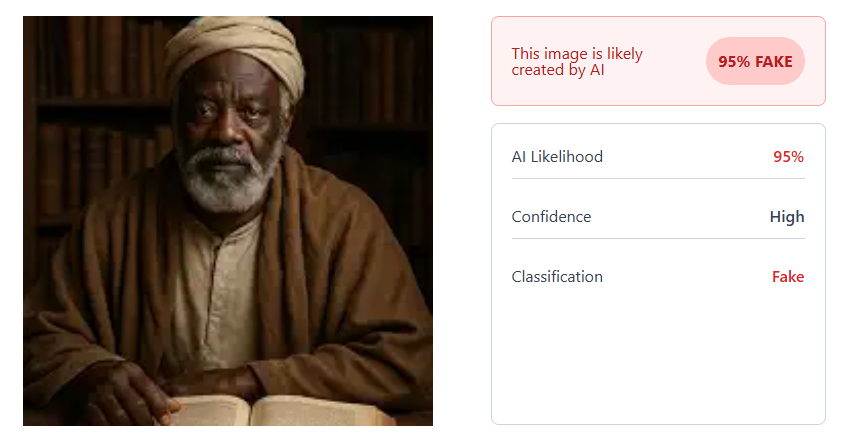
So a growing number of listings in this category carry a portrait that was generated rather than taken. The composition is remarkably consistent: an older man in robes and a head covering, hands resting on an open book, a wall of blurred leather spines behind him. It is a costume that signals "biblical scholar" without any of the work that would earn the title.
Before the checks, one thing worth saying plainly, because this flag is easy to misread.
We are not taking a stand against AI images. We use them ourselves. Our short-form video and a fair amount of our social artwork is generated, the way most publishers' now is, and anybody who looks closely at it will work that out in a moment. It is eye candy and it does not claim to be anything else. We have never attached a name to one of those faces, given it a biography, or told you it spent forty years studying Ge'ez.
An author portrait is a different kind of object. It is not decoration. It is a claim, and a specific one: this is the person who did the work. Putting a generated face there, or a stock model's face, does not dress up a page. It tells a customer something untrue about who wrote the book they are about to pay for, at the exact moment they are deciding whether to trust it.
So the tool is not the problem. The claim is, and the claim is rarely just the picture. The portrait tends to arrive with a name attached, then a biography, then a sentence about decades of study, then a line on the listing calling the whole assembly a biblical scholar and the book his life's work. Each piece props up the next, and the photograph is what makes the rest feel like a person rather than a paragraph.
Nobody is deceived by eye candy that admits what it is. They are deceived by an expert who does not exist.
You can check this yourself in about two minutes.
Reverse image search the portrait. This is the single most effective check on the list and it takes about five seconds. Right click the author photo, choose Search with Google Lens, then click the Exact matches tab in the results panel. Exact matches is the one that matters: it finds the same file rather than pictures that merely look similar.
There are three possible outcomes.
The photograph turns up on a university faculty page, a conference programme, a publisher's site or a professional profile. That is a real person with a real position, and the check is over.
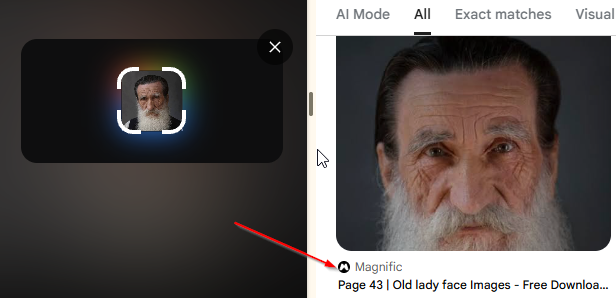
It turns up in a stock photo library. Somebody searched for a picture that looked like a biblical scholar and downloaded one. We ran this check on a bestselling edition in this category and found its author portrait sitting on a free stock page of "Gutenberg portrait" images, alongside a dozen interchangeable old men with beards and open books. The image is real in the sense that it is a photograph. It is not a photograph of the author.
It turns up nowhere at all. That usually means it was generated rather than taken, because it did not exist until somebody asked for it.
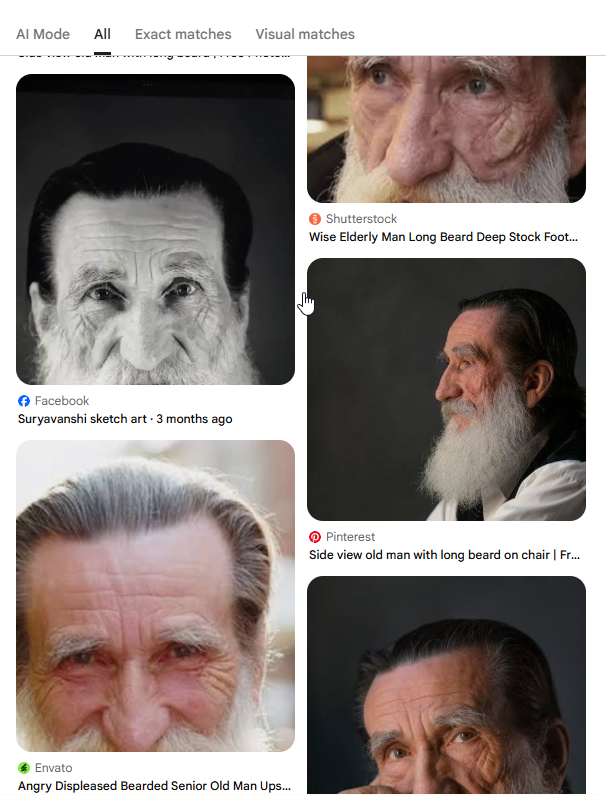
Those last two outcomes are the same trick in two forms. Buying a stock photograph of a suitably wise-looking stranger is the older approach, and it has the drawbacks you would expect: a licence to comply with, a limited pool to choose from, and the possibility that the same face turns up on somebody else's book. Generating one solves all three at once. There is no licence, the variety is unlimited, and the face has never appeared anywhere before because it did not exist until it was asked for.
Both are still in circulation, which is why the check has to catch both. It also means the useful question is not "was this made by a computer." It is "is this the author." Both answers here are no, and the second question is the one you can actually settle.
Only the first outcome is good news. The other two mean the same thing in practice: the face on the author page belongs to somebody who did not write the book.
Zoom in on the background text. Image generators cannot write. Book spines, page text and any lettering behind the subject come out as convincing-looking gibberish that falls apart the moment you look closely. In a photograph of a person surrounded by books, you should be able to read at least one title.
Look at the hands, and at anything small and paired. Fingers on the open book, earrings, glasses hinges, collar buttons, the weave of a fabric where it folds. Generated images still produce extra knuckles, mismatched pairs and detail that dissolves under magnification.
Run it through an AI image detector. The screenshots on this site come from ZeroGPT's image detector, which is free and takes a drag and drop. These tools are probabilistic rather than conclusive, and they do return false positives, so a high score on its own proves nothing. Alongside a portrait that reverse-searches to nowhere and a background full of unreadable lettering, it is worth taking seriously.
None of these signs is decisive by itself. The check that actually settles it is the one the photograph is there to distract you from: does this person have a track record? Search the name. Look for other publications, academic affiliations, conference papers, prior translation work, anything at all in biblical studies or Ge'ez. Real translators leave a trail you can find in under a minute.
If the portrait belongs to a stock library or to nobody, and the name returns nothing but the Amazon listing itself, you are not looking at a translator. You are looking at a product.
Red Flag: Claimed Scholarship, Basic Facts Wrong
Being wrong about the Ethiopian canon is forgivable. Most people have never encountered it, the English-language material is thin, and somebody assembling a collection of apocrypha who describes it as exactly that owes nobody an apology.
What is not forgivable is claiming authority you have not earned, and then demonstrating in the same listing that you have not earned it.
Look at how the edition describes whoever made it. "Written by biblical scholars." "The biblical scholar [name]." "A lifelong student of the Ethiopian Orthodox tradition." "Decades recovering, studying and curating sacred texts." "Faithfully translated from the original Ge'ez."
Now check that claim against the one fact the claim is about. The Ethiopian Orthodox Tewahedo Church recognises 81 books. That number is on the first page of a Google search for "Ethiopian Bible how many books." Finding it requires no Ge'ez, no archive, no institutional access and no decade of study. It takes about forty seconds.
So when a listing advertises a biblical scholar on the cover and 88 books beside it, those two claims are in the same sentence and they cannot both be true.
This is not really an accusation. It is closer to arithmetic. Consider the sentence:
I hold a PhD in mathematics from MIT. I cannot pass a high school algebra test.
Nobody needs that explained. It does not describe an unusually forgetful mathematician, or one who was ill the week algebra came up. Holding that degree consists in part of knowing that material, so the two halves eat each other.
And the right response is not simply to raise an eyebrow. Faced with someone who cannot pass the algebra test, you do not conclude that they are a doctor of mathematics with an unusual gap. It is reasonable to conclude that the claim about the degree is false, and a careful person would conclude exactly that.
Worth being precise about what "false" attaches to. It attaches to the claim, not necessarily to the person's honesty. People can sincerely overestimate their own expertise, and a publisher can print a credential a marketing writer invented. We are not in a position to know which, and neither are you. But the claim itself, measured against the book carrying it, does not hold.
"A lifelong student of the Ethiopian Orthodox tradition, decades spent recovering and curating sacred texts," beside a cover reading 88 books, is the same sentence in different clothes. To study a subject is to come to know its basic facts. The credential and the error cannot both stand, and the one you can verify in forty seconds is the error.
A person who has genuinely spent years with this canon is the last person on earth who would print the wrong number for it. The credential is not merely unsupported by the book. It is contradicted by it, on the cover, in the same glance.
Some other things a claimed expert would not do: list 1 Clement as an Ethiopian text, translate the Old Testament from the Hebrew Masoretic rather than the Greek Septuagint, count the Shepherd of Hermas among the canon, or leave Esther out.
The test is not "is this person a scholar," which you cannot easily determine. The test is does the book contradict the credential printed on it, which you can see from the listing page before you spend anything.
For what it is worth, we make no scholarship claim ourselves. We are a publisher. We established what belongs in the canon, found the best available public domain translation of each book, named it, and put archaic English into modern prose. The scholarship is Brenton's, Charles', Horner's, Harden's, Tattam's and Grebaut's, and it is credited to them everywhere it appears. Those are two different jobs and we only do one of them.
Red Flag: No Source Attribution
A legitimate edition tells you where its translations come from. Which translator did the work? What year was the translation published? What language was the source text? Was it translated from Ge'ez, or from a secondary source? If the text is compiled from multiple translators, which books come from which sources?
If the listing and the book itself do not name a single source, the publisher either does not know where the text came from or does not want you to know. Both are disqualifying. You would not buy a history book that cited no sources. Do not buy a Bible that does the same.
Red Flag: The Old Testament is Based on the Wrong Text
This one requires a small amount of background, but it is the clearest sign that a publisher did not do even basic research on the Ethiopian Bible.
The Ethiopian Old Testament was translated from the Greek Septuagint, not the Hebrew Masoretic Text. This is not controversial scholarship. It is the first fact you learn when you study the Ethiopian biblical tradition. The Ge'ez Bible descends from the Greek, just as the Latin Vulgate descends from a mix of Greek and Hebrew sources.
Most English Bibles (KJV, ESV, NIV, NASB) translate from the Hebrew Masoretic Text. That is appropriate for those traditions. It is wrong for an Ethiopian Bible. If an edition claiming to be an Ethiopian Bible uses a Masoretic-based translation for its Old Testament, the publisher did not bother to look up what the Ethiopian Bible actually is before assembling the product. One reviewer of a bestselling edition on Amazon noted exactly this: "Most of the translations are in KJV, with added text."
A legitimate Ethiopian Bible uses a Septuagint-based source for the Old Testament. That is not optional. It is the correct textual tradition.
What to Look For Instead
A real Ethiopian Bible edition will:
- Name its sources. Every translation attributed to a specific translator and date.
- Document its methodology. How decisions were made about which texts to include and which translations to use.
- Honestly list which books are present and which are not. No edition has every book in perfect form. The honest ones say so.
- Format the text for actual human reading. Readable font sizes, clear chapter and verse divisions, proper paragraph breaks.
- Not pad the listing with thousands of "bonus" texts that have nothing to do with the Ethiopian canon.
The bar is not high. It just requires treating the Ethiopian biblical tradition as something worth doing properly.
We have written detailed examinations of two specific fake editions. Read those if you want to see these red flags in action:
You can also read our Sources & Methodology page to see how we handle attribution, provenance, and editorial decisions in our own edition.
We think the Ethiopian canon deserves better. We built our edition to prove it. Every source is named. Nothing is copy-and-paste. Every archaic translation was rephrased into modern English. See what a real edition looks like.