“I was looking for an Original Ethiopian Bible, not bits and pieces of the Ethiopian Bible. Had this been stated in the product description, I would not have bought it.”
Dennis Shays, verified purchase, February 20269 of 10
Red flags raised
Checked 24 August 2026
- ✗ The book count is not an Ethiopian count
- ✗ The page count cannot hold the text
- ✗ Digital vault or bonus padding
- ✗ No Books of Church Order
- – 1 Clement in place of Qalementos not checked
- ✗ The formatting is a wall of text
- ✗ Stock photo or AI generated portrait
- ✗ Claims scholarship, gets the canon wrong
- ✗ No source attribution
- ✗ Old Testament from the wrong base text
1 point we have not checked, shown as unchecked rather than counted either way. Each row is one entry from our checklist for spotting a fake Ethiopian Bible, which explains how to run every test yourself. Our own edition scores 0 of 10 on the same ten points.
"The Complete Ethiopian Bible in English: 88 Books" by Edward Jones is the bestselling Ethiopian Bible on Amazon. It has over 1,400 reviews, claims more than 50,000 copies sold, and at the time of writing sits at #1,456 in all of Books. The listing describes it as "the only authentic and faithful translation of the ancient Ethiopian Orthodox canon by the biblical scholar Edward Jones."
It is 539 pages.
The Math
The Ethiopian Orthodox canon contains approximately 1.2 million words across 81 books. That is not a rough estimate. You can count. Genesis alone is over 38,000 words. The Psalms run to 43,000. The New Testament is around 180,000. Add in Enoch, Jubilees, the three books of Meqabyan, the Sinodos, the Didascalia, Qalementos, Mashafa Kidan, Josippon, and you are well past a million words.
A standard paperback fits roughly 250-300 words per page with readable formatting. At 539 pages, this book can hold roughly 150,000 words at most. That is about 12% of the Ethiopian canon.
Ethiopian canon: ~1,200,000 words
This book's capacity: ~150,000 words (539 pages)
That is roughly 12% of a complete Ethiopian Bible.
You do not need to open this book to know it is not complete. The page count makes it physically impossible. There is no font size, no margin width, no column layout that fits 1.2 million words into 539 pages in a way that a human being can read.
The Number on the Cover
Now look at the number in the title. The Ethiopian Orthodox Tewahedo Church counts its own canon at 81 books: 46 Old Testament, 35 New Testament. Not 88. So where does 88 come from?
66 plus 22. The familiar Protestant Bible, plus the apocrypha a Catholic or Orthodox edition already carries, counted book by book.
That is a real number describing a real collection. It is simply not the Ethiopian one. A cover advertising 88 books is announcing, in public and in advance, that what is inside is a Protestant Bible with apocrypha attached. You can work that out before you buy it, if you happen to know that Ethiopia counts to 81.
Almost nobody knows that. Which is rather the point.
The Table of Contents
But we did open the free Amazon preview. Here is the table of contents:
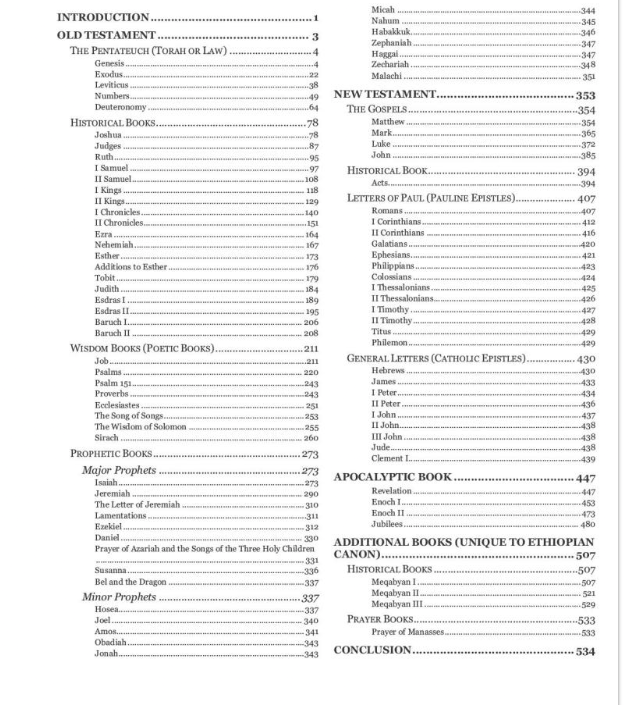
Read that carefully. The standard Old Testament runs from page 4 to about page 350. The New Testament runs from page 353 to roughly page 450. Then a few apocryphal and apocalyptic books. And then, at the very end:
"ADDITIONAL BOOKS (UNIQUE TO ETHIOPIAN CANON)", starting on page 497.
The section that supposedly makes this an Ethiopian Bible, the whole reason anyone would buy this instead of a regular Bible, begins on page 497 of a 534-page book. That is 37 pages. The entire Ethiopian-unique content of this "Complete Ethiopian Bible" fits in 37 pages.
And what is in those 37 pages?
- "Historical Books" (appears to be a fragment of Jubilees)
- Meqabyan I, II, and III
- "Prayer Books"
- Prayer of Manasseh
That is it. That is the "complete Ethiopian canon."
What is Missing
Here is what the Ethiopian canon actually requires in its Books of Church Order and the Josippon, and what this edition contains:
| Required Book | Present? |
|---|---|
| Sirate Tsion (Order of Zion) | Missing |
| Te'ezaz (Commandment) | Missing |
| Abtilis (Statutes of the Apostles) | Missing |
| Gitzew (Apostolic Canons) | Missing |
| Didascalia | Missing |
| Mashafa Kidan (Book of the Covenant) | Missing |
| Qalementos (Ethiopic Clement) | Missing |
| Josippon (Zena Ayhud) | Missing |
Zero out of eight Church Order books, and no Josippon. Not one single Book of Church Order is present. The Josippon, the final book of the Old Testament in the broader canon, is also absent. These are the texts that define the Ethiopian canon. They are the reason the Ethiopian Bible is different from every other Bible. And this "complete" edition does not contain a single one of them.
The Didascalia alone is 26 chapters. Qalementos fills three books. The Sinodos contains four separate texts with dozens of canons each. Josippon runs over a hundred chapters. None of them are here. Not abbreviated, not summarized. Simply absent.
The Buyers Already Know
The one-star reviews tell the story better than we can. These are verified purchases from people who trusted the listing:
★★★★★
"When I open this Original Version Ethiopian Bible In English, there is a Disclaimer that states, 'This book represents a unique selection of sacred texts from the Ethiopian Bible, carefully selected and curated....' Well, I was looking for an Original Ethiopian Bible, not bits and pieces of the Ethiopian Bible. Had this been stated in the product description, I would not have bought it."
Dennis Shays, Verified Purchase, February 2026 (20 people found this helpful)
Read that again. The book itself contains a disclaimer admitting it is "a unique selection," not the complete canon. That disclaimer does not appear anywhere in the Amazon listing. It is hidden inside the cover, where you only find it after you have already paid.
★★★★★
"The advertized audio, video, the digital 713 Apocophal books, and the private access area are NOT accessable. I spent 3 hours online and on the phone with tech support trying to solve the issues, all to no avail. I already owned the Ethiopic Bible and its 88 books. The only reason I purchased this volume was for these add-ons."
pjtech, Verified Purchase, April 2025 (67 people found this helpful)
★★★★★
"This edition is a disgrace. The tiny type font looks like 6 pt or smaller, and each chapter contains no paragraph breaks between - each page is just a wall of text. The first 100 pages were printed off-centered so the type is cut off on one side; the rest of the book has 1/8" margins.... beware: saying it's 801 books is a lie. It's 88 books.... The other 713 books touted on the cover are strictly available online using a QR code to access Jones' website."
Christopher L. Hodapp, Verified Purchase, March 2026 (25 people found this helpful)
★★★★★
"I'm highly disappointed in this book, it is not an original, nor is it translated from the original. It has inconsistencies throughout the books.... Most of the translations are in KJV, with added text.... Upon doing some research, I found that the majority of the Ethiopian Tewanedo Orthodox Bible has not been translated into English. So there isn't a complete Ethiopian Bible in English."
tatyana, Verified Purchase, May 2026
★★★★★
"This is marketed as The Complete Ethiopian Bible (88 Books) - a sacred text rooted in African Christianity and Ethiopian Orthodox tradition. However, when I opened the book, I was shocked to find illustrations depicting Jesus and the apostles as clearly white/European in appearance. For a Bible that comes from one of the oldest African Christian traditions in the world, this feels historically inaccurate and culturally inappropriate."
Maxis, Verified Purchase, March 2026 (30 people found this helpful)
★★★★★
"I am not too happy with the fact that I have just been able to start reading this and Genesis chapter 32 and 33 are identical."
Sandra, Verified Purchase, April 2026
Duplicate chapters. Missing pages. Digital bonuses that do not work. A hidden disclaimer contradicting the listing. European illustrations in an Ethiopian Bible. And the text is so small that multiple reviewers describe needing a magnifying glass to read it.
This is what 50,000 people paid $43 for.
The Formatting
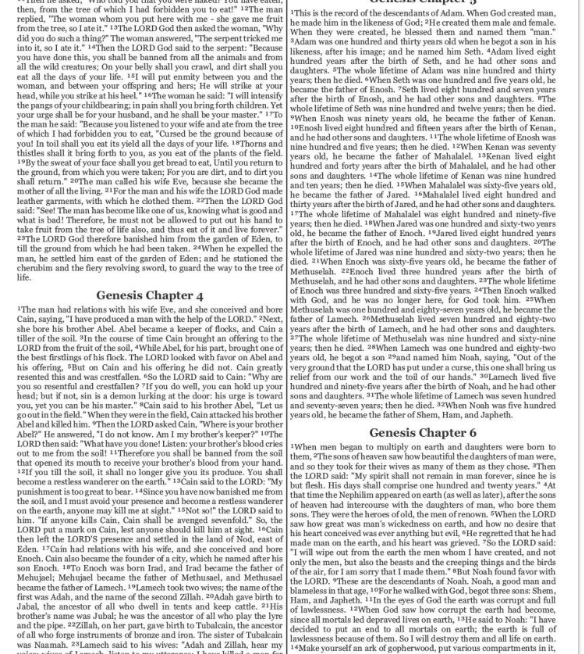
The formatting is the same lazy copy-and-paste job found in every edition in this category. Small text, no paragraph breaks, tight margins, walls of unreadable text. One reviewer reported the first 100 pages were printed off-center with text cut off on one side. This is not a book designed to be read. It is a product designed to be purchased, which is a different thing entirely.
"Written by Biblical Scholars"
The listing includes this line, prominently:
OVER 50,000 COPIES SOLD. BUY THE ORIGINAL VERSION WRITTEN BY BIBLICAL SCHOLARS.
Biblical scholars. Let that sit for a moment.
A biblical scholar working on the Ethiopian canon would know that the Ethiopian Old Testament is translated from the Greek Septuagint, not the Hebrew Masoretic Text. This book uses a standard English translation based on the Masoretic. A biblical scholar would know that the Ethiopian canon includes eight Books of Church Order and the Josippon. This book contains none of them. A biblical scholar would know there are three books of Meqabyan unique to the Ethiopian tradition. This book mentions "Maccabees" in the table of contents and appears to confuse them with the Catholic deuterocanonical books.
These are not obscure details. This is the kind of thing you would learn in the first ten minutes of reading the Wikipedia article on the Ethiopian Bible. A "biblical scholar" specializing in the Ethiopian canon who does not know what is in the Ethiopian canon is not a scholar. They are a fiction printed on a product listing.
The listing also describes this as "the only authentic and faithful translation of the ancient Ethiopian Orthodox canon by the biblical scholar Edward Jones." It lists "Anonymous" as co-author.
We have not been able to find any published scholarship, academic affiliation, or prior translation work attributed to an Edward Jones in the field of Ethiopian biblical studies. The publisher is listed as "Independently published" under the brand name "Majosta." The ISBN leads nowhere useful.
So hold three things next to each other. The listing promises "the only authentic and faithful translation of the ancient Ethiopian Orthodox canon." Verified buyers report the text reads as KJV with material added to it. The table of contents gives everything unique to Ethiopia 37 pages at the back.
Those three statements cannot all be describing the same book. Readers can decide for themselves which one is doing the work.
The Author Photo
There is one more thing we can check about the author, and it does not require finding any scholarship at all. It requires right clicking a photograph.
The Amazon author page carries a portrait: an older man with a full white beard, seated, holding an open book. It is the sort of image that says scholar before you have read a word.
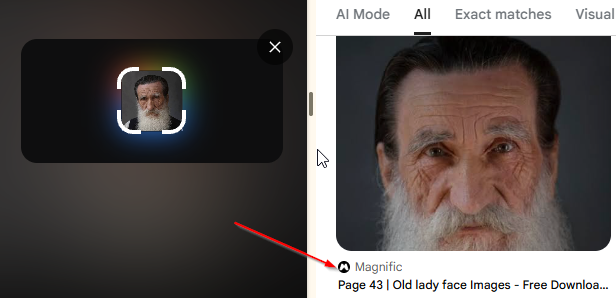
It is a stock photograph. Not an AI generation, which is worth being precise about: this is a real photograph of a real person, taken by a real photographer. That person is simply not Edward Jones.
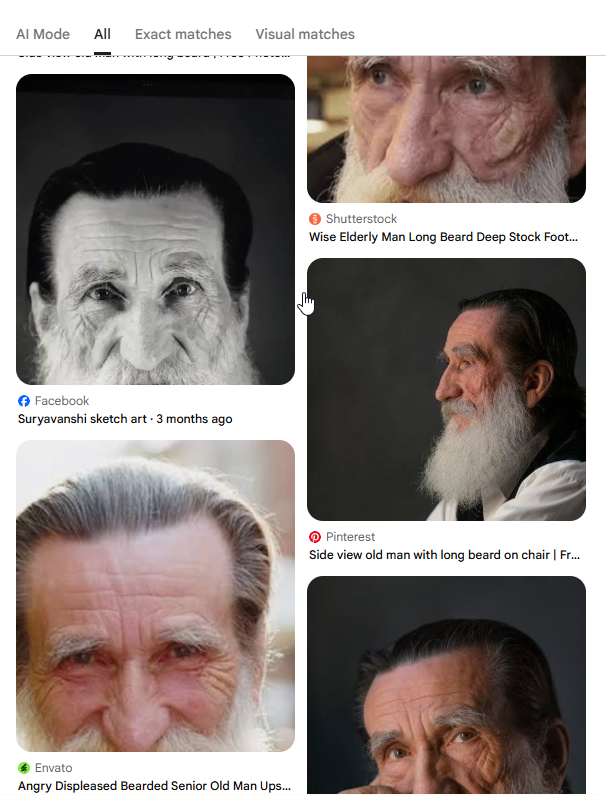
So the man on the author page is a model whose face appears across several stock libraries and, at least once, as a stranger's drawing exercise. He is doing a great deal of work for a listing that describes its author as a biblical scholar and its book as the only authentic translation of the Ethiopian canon.
We are not going to tell you what to conclude from that. We will point out that it took about five seconds to check, that anyone can repeat it, and that we have written down how to run this test along with the eight others.
The "1,801 Sacred Books" Digital Bonus
The listing leads with its digital bonuses: "1,801 sacred books" in a digital library, audio versions, video content, a "Private Members Chat." This is the centerpiece of the offer. It is the first thing the buyer sees.
There is a well-worn playbook in this corner of Amazon. Take material that is free everywhere. Bundle it into a "library." Put an enormous number on the bundle. Lead with the bundle rather than the book. Deliver it by QR code to a site you control, after the sale. Done properly, the number does all the persuading and nobody ever has to write a sentence that is flatly false.
Here is what this listing does. The "1,801 sacred books" are public-domain text collections: pseudepigrapha, apocrypha, early church writings, the same material available free on Internet Archive, Project Gutenberg, CCEL, and dozens of academic repositories. The audio is text-to-speech. The "Private Members Chat" is a Discord server or equivalent. None of it is printed in the book; it is reached by QR code. And as multiple verified buyers report, much of it does not work at all. One reviewer spent three hours on the phone before giving up.
Same playbook. Same order of operations. Same QR code.
We are not going to tell you what to call that. We are going to tell you what is in the box.
50,000 Copies
This book has sold over 50,000 copies at roughly $43 each. That is over two million dollars in revenue from a product that contains 37 pages of Ethiopian-unique content, zero Books of Church Order, no Josippon, no identifiable translator, and formatting that suggests nobody involved ever opened the file and read a page.
Fifty thousand people searched for the Ethiopian Bible, trusted the listing, and paid for something that does not exist inside the cover. That is not a publishing failure. It is a consumer protection problem.
The Ethiopian Orthodox Bible Project warned about this exact pattern in 2025. Nothing has changed. The books keep selling because the buyers do not know what the Ethiopian canon actually contains, and the listings are engineered to prevent them from finding out until the package arrives.
We are building a different kind of edition. Every source is named. Every book's provenance is documented. All eight Books of Church Order are present, along with the Josippon, sourced from identified public-domain scholarly translations. And nothing is copy-and-paste: every archaic source text was rephrased into modern English so the book reads like something written in this century. Our Sources & Methodology page explains exactly what we used and where it came from, because we think the Ethiopian biblical tradition deserves better than this.