7 of 10
Red flags raised
Checked 23 August 2026
- ✗ The book count is not an Ethiopian count
- ✗ The page count cannot hold the text
- ✗ Digital vault or bonus padding
- – No Books of Church Order not checked
- ✗ 1 Clement in place of Qalementos
- ✓ The formatting is a wall of text
- ✗ Stock photo or AI generated portrait
- ✗ Claims scholarship, gets the canon wrong
- ✗ No source attribution
- – Old Testament from the wrong base text not checked
2 points we have not checked, shown as unchecked rather than counted either way. Each row is one entry from our checklist for spotting a fake Ethiopian Bible, which explains how to run every test yourself. Our own edition scores 0 of 10 on the same ten points.
“This shamefully abridged blasphemy should be pulled from the market.”
Chris, verified purchase, February 2026Most of the editions we have looked at hide behind microscopic type. You open the Look Inside preview, find a wall of 6-point text with no paragraph breaks, and the argument makes itself.
This one is different, and it is worth being fair about that up front. Kevin J. Gregory's "The Ethiopian Bible: The Full Restoration of The Ancient Ethiopian Canon" is set in three columns at a readable size, with numbered verses and clear chapter headings. If you look at a single page in isolation, it looks like a real book.
That is the problem.
The book is 271 pages.
The Arithmetic
The Ethiopian Orthodox Tewahedo canon runs to roughly 1.2 million words. We counted our own edition from the manuscript, with headings and markup stripped, and it clears 1.2 million words. Our edition prints that text in over 700 pages, at 8-point type in three columns on a large page, at more than 1,600 words a page. We went down to 8-point specifically because the arithmetic demanded it, and because Amazon will not manufacture a paperback much past 828 pages.
Gregory's book is 8.5 x 11 inches, so the page area is almost identical to ours. Content begins on page 7, which leaves about 264 pages of text.
Give his pages our density, which is more generous than his own type allows: 264 pages at 1,600 words per page is about 422,000 words.
That is roughly a third of the canon, under the most favourable assumption available to him.
But his type is visibly larger than our 8-point setting. That is the point of the edition, and the listing sells it: "a study-friendly layout," "a clear, comfortable 8.5x11 format designed for effortless reading over long sessions." Larger type means fewer words per page. At around 10-point, 264 pages holds something closer to 270,000 words, which is a little over a fifth of the canon.
One verified purchaser, holding the physical book, reached the same conclusion from the other direction: "This is only maybe a quarter of the WHOLE Bible."
She arrived at that by reading it. We arrived at it by multiplying page count by words per page. Those two methods agreeing is usually a sign that both are right.
The readable formatting is not a mitigating factor here. It is the evidence. An edition can be complete or it can be comfortable at 271 pages. It cannot be both, and this one has chosen, without saying so on the cover.
1,943 Chapters in 264 Pages
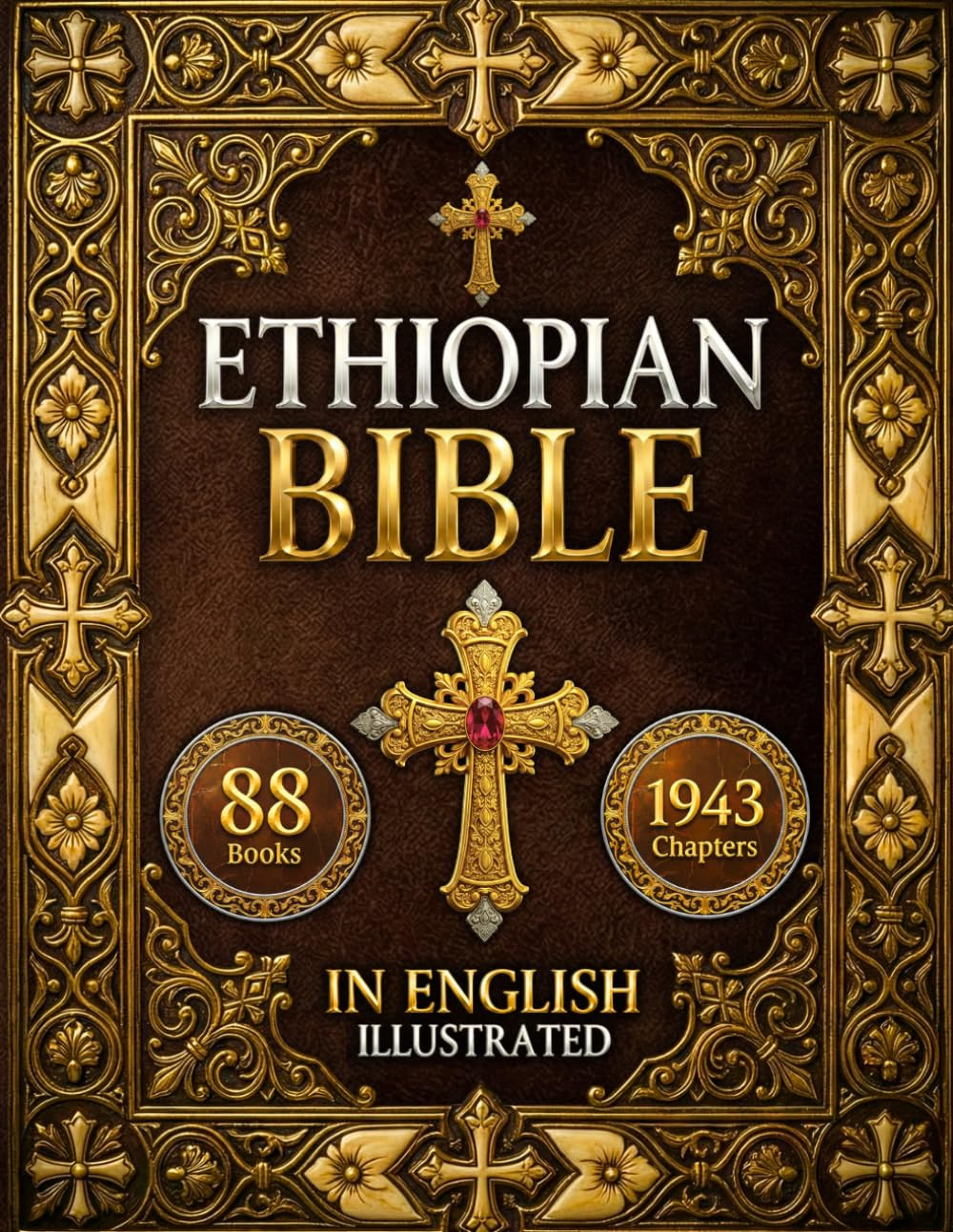
The cover advertises 1,943 chapters. Our edition contains 1,578 chapters across over 700 pages, which works out to about two chapters per page.
His claim works out to 7.4 chapters per page, roughly three and a half times as dense, in a book with larger type than ours.
A chapter of scripture averages somewhere between five hundred and eight hundred words. Seven of them on a page means they are not chapters in any sense a reader would recognise. The buyers describe exactly what that looks like in practice. "John 3 has only 8 verses instead of 36 verses." "Mark chapter 14 has only 10 verses and chapter 15 begins with Yeshua standing in front of Pilate." "Psalms has over 100 chapters and then only translates about 6 verses of each chapter."
The Table of Contents
The contents list runs to 88 numbered books. Here is what the page numbers allow each one.
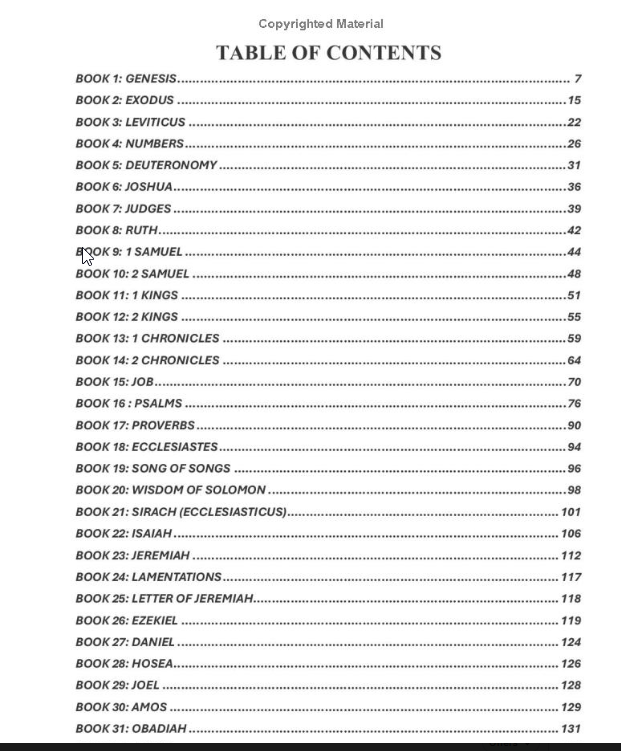
- Genesis: pages 7 to 15. Eight pages.
- Psalms: pages 76 to 90. Fourteen pages for 150 psalms.
- Jubilees (Mets'hafe Kufale): pages 145 to 150. Five pages.
- 1 Enoch (Henok): pages 150 to 158. Eight pages. Our Henok runs 35,693 words.
- Matthew: pages 171 to 176. Five pages.
- Revelation: pages 231 to 234. Three pages.
- Didascalia: pages 241 to 244. Three pages. Harden's translation runs 43 chapters.
The last book in the contents, "Ethiopic Canticles," begins on page 270 in a book that ends on page 271.
What Is Not In It
Read the first thirty-nine entries of the contents list and something is missing that has nothing to do with the Ethiopian canon at all.
There is no Ezra. There is no Nehemiah. There is no Esther.
Those three books are in every Bible in Christendom. They are in the Protestant canon, the Catholic canon, and the Ethiopian canon. A volume that calls itself "The Complete Collection of All 88 Books" and "The Complete Tewahedo Scriptures" does not contain the Book of Esther.
Against the actual Ethiopian canon, the list is also missing 1 Esdras, Ezra Sutuel, Baruch, the Rest of the Words of Baruch, Tegsat, and the Josippon.
A verified purchaser who plainly knows the canon reached the same list independently, in February 2026:
The Old Testament is missing (from the Tawahedo canon) Ezra and Nehemiah, 2nd Ezra and Ezra Satuel, Esther, Baruch, and Baruch 4, as well as the Book of Josephus the Son of Bengarian.
Chris, verified purchase, February 2026
"The Book of Josephus the son of Bengarian" is the Josippon, which closes the Old Testament in the Ethiopian order. He is reading the same contents page we are and finding the same holes.
The Missing Ethiopian
The same reviewer lists passages he could not find at all. John 1:14. John 3:16. First Corinthians 11:27 to 29. Enoch 1:9, which is the verse the Epistle of Jude quotes.
And Acts chapter 8, verses 26 to 39.
That is the account of Philip meeting an Ethiopian court official on the road to Gaza, finding him reading Isaiah 53, and baptising him. In Ethiopian tradition it is the founding conversion, the moment the faith reaches Ethiopia, and it is the reason the Ethiopian church understands itself as apostolic.
It is not in this book.
An edition titled "The Full Restoration of The Ancient Ethiopian Canon" has dropped the passage in which an Ethiopian becomes a Christian.
Books 74 and 75
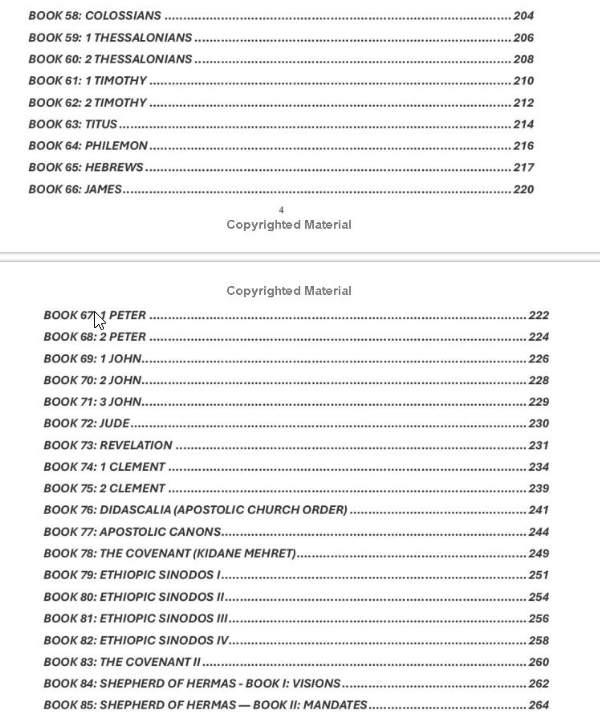
Our checklist for spotting a fake Ethiopian Bible carries this as one of its entries: if the contents list says "1 Clement," the publisher does not know what the Ethiopian canon contains.
The Ethiopian canon includes Qalementos, a Ge'ez work in seven books, translated into French by Sylvain Grebaut across the Revue de l'Orient Chretien between 1911 and 1928. 1 Clement is a Greek letter written from Rome to Corinth around the year 96. Different author, different language, different content, different purpose, different millennium. The names look alike in English and nothing else about them matches.
This edition lists 1 Clement as Book 74 and 2 Clement as Book 75. 2 Clement is an anonymous Greek homily from the second century, and it is not in the Ethiopian canon by anyone's reckoning.
Books 84, 85 and 86 are the Shepherd of Hermas, split into its Visions, Mandates and Similitudes and counted as three separate books. The Shepherd of Hermas is a second-century Roman text. It is not in the Ethiopian canon either.
Books 79 through 82 are "Ethiopic Sinodos I" through "Ethiopic Sinodos IV." The Sinodos is a collection, and the four texts inside it have names: Sirate Tsion, Te'ezaz, Gitzew and Abtilis. Numbering them I to IV without naming them is what you do when you know a four-part thing exists and do not know what the four parts are.
The same reviewer flags something we had passed over. Books 78 and 83 are listed as "The Covenant (Kidane Mehret)" and "The Covenant II." The Church Order book is Mashafa Kidan, the Book of the Covenant, which the Ethiopian canon counts as two. Kidane Mehret is a different thing entirely: the Covenant of Mercy, a Marian devotion. The names share a word in Ge'ez and nothing else. His reading of the two entries: "not those from the Tawahedo canon, but an ambiguous split of the Covenant of Mercy from the Marian tradition."
Take out the two Clements and the three slices of Hermas, and the 88 is already 83.
"Faithfully Translated From The Original Ge'ez Text"
That phrase is from the listing. So is this one: "Faithfully preserves the true Tewahedo tradition, with no Western alterations or reinterpretations."
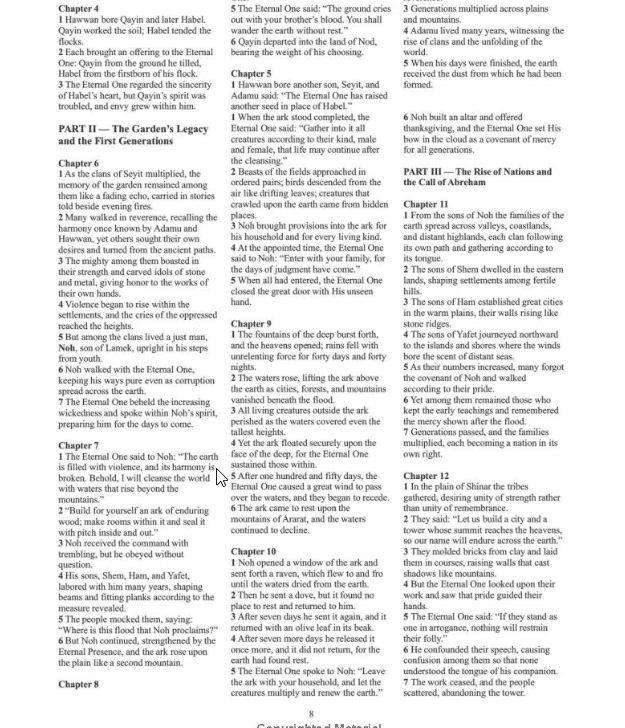
On this page, Eve is Hawwan. Cain is Qayin. Abel is Habel. Adam is Adamu. Seth is Seyit. Noah is Noh. Japheth is Yafet. God is "the Eternal One."
Some of these are defensible transliterations. "The Eternal One" is not a translation of anything in the Ge'ez; it is an editorial choice, and it is precisely the kind of Western reinterpretation the listing promises it has avoided. One reviewer noticed: "They call God 'The Eternal One' instead of YHWH." Another put it more plainly: "The writer made up some of his own character names."
Read the prose itself and it is not a translation at all. It is a retelling. "Violence began to rise within the settlements, and the cries of the oppressed reached the heights." "Noh walked with the Eternal One, keeping his ways pure even as corruption spread across the earth." That is a summary of Genesis 6 written by someone in the present tense of English literature, not a rendering of a Ge'ez sentence.
The clearest single piece of evidence comes from a verified purchaser, describing Luke chapter 3:
Instead of Luke chapter 3 having a genealogy portrayed, it simply says "Luke placed a genealogy from Joseph to Adam here."
Debi Keefe, verified purchase, August 2026
That is a stage direction standing where the scripture should be. It is the single most economical description of this book that anyone has written.
Genesis 1:1
The clearest evidence in this entire review comes from someone who liked the book.
A verified purchaser gave it four stars in April 2026. She admires the binding, notes the illustrations, says she looks forward to reading it, and signs off thanking the author by name. In the middle of that review, as a point of interest rather than a complaint, she transcribes the first verse of Genesis as this edition prints it:
In the beginning, before the shaping of the mountains or the tracing of the heavens, the Eternal One stirred the Deep with His unseen breath, and the waters trembled beneath His radiance.
Genesis 1:1, as printed in this edition, transcribed by a verified purchaser, April 2026
Genesis 1:1 is seven words long in most English Bibles. "In the beginning God created the heaven and the earth." Our own edition, working from Brenton's Septuagint, has "In the beginning God made the heaven and the earth."
The sentence above is not a translation of that verse from any language. There is no Ge'ez behind "the tracing of the heavens." There is no manuscript in which the Deep trembles beneath anyone's radiance. It is original English composition, and a rather nice piece of it, printed as scripture in a book whose listing promises "no Western alterations or reinterpretations."
The same reviewer records the rest of the pattern without drawing a conclusion from it: "Adam and Eve, Cain and Abel are called different names." "This edition calls God 'The Eternal One.'" "This seems very poetic yet worded differently than other Ethiopian Bibles."
"Worded differently than other Ethiopian Bibles" is carrying a great deal of weight in that sentence. It is worded differently because it is not a translation of the Ethiopian Bible. It is somebody's original prose, and the buyer paid around fifty dollars in the belief that they were buying the former.
A hostile reviewer can be dismissed as disgruntled. This one gave it four stars, thanked the author by name, and transcribed the evidence herself.
The Author Page
The credited author is Kevin J. Gregory. The Amazon author page carries a portrait of an older man in robes and a head covering, hands resting on an open book, in front of a wall of blurred leather spines.

Detection tools are probabilistic and they do produce false positives, so we will not tell you what that score proves. We will tell you what we could not find: any published scholarship, academic affiliation, institutional post, or prior translation work in Ethiopic studies attributed to a Kevin J. Gregory. Translating a 1.2 million word canon out of Ge'ez is roughly a career. It leaves a trail.
The listing says the collection was "faithfully translated from the original Ge'ez text." It does not say by whom, or when, or from which manuscript.
The Buyers Already Know
Of 918 ratings, roughly 19% are one star. That is not a book with a few disappointed customers. That is close to one buyer in five going back to write a warning. You can read them yourself, and we would encourage it. We have selected four below, but the pattern is the point, not our selection.
This is not a complete Bible. The books are not printed accurately. Chapter 6 is printed right after chapter 4. It is missing a lot of information. This bible seems to paraphrase the summary instead of the actual text.
Samantha, verified purchase, August 2026
This version of the Ethiopian Bible is incomplete and a great deal of the Bible is missing. For example Mark chapter 14 has only 10 verses and chapter 15 begins with Yeshua standing in front of Pilate.
Robert Metz, verified purchase, August 2026
SAYS "FULL" I took that as complete. It is not. If you are looking for the COMPLETE Ethiopian Bible, this is NOT it.
Daniel, verified purchase, June 2026
Extremely, unacceptably abridged. No Chapter goes beyond 10 verses. Many of Jesus' teachings and others lost because of this.
This shamefully abridged blasphemy should be pulled from the market. "Add nothing to it, nor subtract anything from it" says the LORD your God!
However, it does contain some nice additions by accident. The Epistles of Clement are a good read even if they're not the Ethiopian canon. Overall I'll bump it up to a second star. I might give it to one of my kids as a gentle introduction to the scripture.
Chris, verified purchase, February 2026
Chris is the most valuable review on the listing, and he gave it two stars rather than one. He identifies the missing Old Testament books by name, spots the Clement substitution, spots the Covenant misattribution, knows the Shepherd of Hermas is outside the canon, and then goes out of his way to say the Epistles of Clement are a good read and the Ethiopic Church Order is sound advice. A reviewer who finds things to praise in a book he is criticising is a reviewer worth believing.
The Digital Extras
The listing closes with "extra digital resources featuring additional sacred texts such as 'The Legend of Abram's Conversion', 'The Book of Adam and Eve', and more."
Both of those are public domain and free. The Book of Adam and Eve has been freely available online for decades.
Digital padding is not proof that an edition is incomplete. It is perfectly possible to imagine a serious volume that also bundles some extra reading.
It is notable, though, that every fake Ethiopian Bible we have run across uses this marketing tactic, and that is reason enough for it to give you pause. A vault of 1,801 sacred books behind a QR code. Audio and video lessons. A members area. A folder of additional texts. It is one of the entries on our checklist for spotting a fake Ethiopian Bible, and the correlation has been consistent enough to keep it there.
These editions compete on the claims of their covers, each one louder, more baroque and more voluminous than the last. This one sets 88 books and 1,943 chapters in gold medallions on a background of tooled leather and jewels. What none of them compete on is the amount of text behind the cover.
The reason is probably just economics. Collecting a few hundred public domain files from Project Gutenberg and putting them behind a download link is an afternoon of work, and it buys a bullet point that sounds enormous. Establishing what the Ethiopian canon actually contains, finding a defensible English source for each of its 81 books, naming every one of them, and typesetting the result into a single readable volume is a different order of task entirely.
If you have done the second, you do not need the first.
The Marketing Is Working
It would be easier to write all of this off as a fringe product nobody buys. That is not what is happening. On 23 August 2026, this edition ranked 10,043 in Books on Amazon, which is the largest category on the site.
We publish books ourselves, so rather than reach for a third party estimate we can give you a reference point from our own sales figures. On 22 August we sold 11 copies of our Apostolic Fathers, which is a fairly typical day for that title. As of 23 August it ranks 41,367 in Books. It is a 311 page paperback at 6x9, priced at $16.50.
A lower number is a better rank. This edition sits at roughly a quarter of that figure.
We are not going to do the multiplication for you, because the relationship between rank and sales is not linear and anyone who tells you it is has stopped being careful. What we will say is that a rank of 10,043 in Books is not a curiosity. Somebody is buying a great many copies of a 271-page Ethiopian Bible with no Esther in it, every single day, and that is as far as the evidence goes.
Which means the covers are working, the medallions are working, and the 88 on the front is working.
What We Are Not Saying
We are not going to tell you what to call this. We have told you what is in it: 271 pages, no Esther, no Ezra, no Nehemiah, no Josippon, two books of Clement that belong to a different tradition, the Shepherd of Hermas counted three times, God renamed, and a genealogy replaced with a note explaining that a genealogy goes there.
You can decide for yourself what that is.
Our Own Position, Stated Plainly
We are not working from Ge'ez either, and we say so everywhere it matters. Our Old Testament rests on Brenton's English Septuagint of 1851, which is the correct textual tradition, because the Ge'ez Old Testament was translated from the Greek rather than the Hebrew. Our Henok and Kufale rest on R. H. Charles, 1912 and 1902, modernized and restructured into the Ethiopian chapter divisions. Several of the Church Order books reach English through French and Latin intermediaries, all of them named. Our Josippon is a documented reconstruction, not a translation from the Ge'ez, and it is labelled as one everywhere it appears. The Didascalia carries gaps that came with its source manuscripts.
Everyone working in this canon has gaps, because the source material has gaps. The difference is whether they are printed where you can see them before you buy, or discovered on page four hundred.
What we do have is documentation in three layers: a note at the head of each book naming the translation behind it, a sources and rights section at the back, and editorial notes at the points where the Ethiopian tradition reads a text differently from the Western consensus. That third layer is the one no assembled edition can produce. Here is ours, printed after 1 Enoch 2:2:
In the Ethiopian commentary tradition (the Andemta), these "angels, the sons of heaven" are read not as fallen spirits but as the righteous line of Seth: men so given to prayer, and so set apart on the holy mountain, that they were called "angels" for their holiness. Their sin was to come down from Mount Hermon and take wives from the daughters of Cain. Read this way, the Book of Enoch does not contradict Genesis, Jubilees, and the Books of Meqabyan but harmonizes with them. This edition follows the Ge'ez text as R. H. Charles rendered it; the interpretation belongs to the tradition.
Editorial note, our edition, 1 Enoch 2:2
You cannot write that paragraph by downloading files. You write it by asking how the church that kept the book reads the book.
Before You Buy Any Edition, Including Ours
Multiply the page count by a realistic words-per-page figure for the type size on the page. If the answer does not reach seven figures, you are holding a selection, whatever the cover says. Then open the table of contents and look for Sirate Tsion, Te'ezaz, Gitzew, Abtilis, the Didascalia, Qalementos and both Books of the Covenant. And check that Esther is in there.
Our edition is over 700 pages, over 1.2 million words, 81 books printed as 90 volumes, with all eight Books of Church Order and the Josippon. Our Sources and Methodology page lists every book and the exact translation behind it, and there is a free sample of the real interior, front matter and the whole of Genesis, so you can run the same test on us.
Run it. We would rather you checked.
One Ask
If any of this was useful, send it to somebody before they buy rather than after.
Almost everyone who ends up with one of these editions had no reasonable way of knowing. The listing said complete. The cover said 88 books. The reviews averaged four stars because most buyers never counted. Checking takes about two minutes and consists of opening the table of contents, looking for the eight Books of Church Order, and multiplying the page count by a realistic words per page. Nobody thinks to do it, because nobody expects a Bible to be padded.
These editions are selling thousands of copies a month on the strength of their covers. The only thing that competes with a cover is somebody who already knows what to look for, telling somebody who does not.
Links to Amazon on this page are affiliate links, including the link to the edition under review. If you buy through one, we earn a commission, including on the book we have just spent three thousand words telling you not to buy, and including on our own Apostolic Fathers, which we cited above as evidence for a claim about sales ranks. We would rather tell you that than have you find it out. Now you know, and you can decide what it is worth. The edition reviewed here is available on Amazon if you want to check any of this for yourself, which we would encourage.