“The font size is way too small to read even with a magnifying glass! No joke, this book is a waste of money, time and energy.”
Verified purchase, January 20267 of 10
Red flags raised
Checked 24 August 2026
- ✗ The book count is not an Ethiopian count
- ✗ The page count cannot hold the text
- ✗ Digital vault or bonus padding
- – No Books of Church Order not checked
- ✗ 1 Clement in place of Qalementos
- ✗ The formatting is a wall of text
- ✗ Stock photo or AI generated portrait
- ✗ Claims scholarship, gets the canon wrong
- – No source attribution not checked
- – Old Testament from the wrong base text not checked
3 points we have not checked, shown as unchecked rather than counted either way. Each row is one entry from our checklist for spotting a fake Ethiopian Bible, which explains how to run every test yourself. Our own edition scores 0 of 10 on the same ten points.
"THE TRUE ETHIOPIAN BIBLE COMPLETE in English" by Kwame Elias Obadiah is, at the time of writing, the top-selling Ethiopian Bible on Amazon. It claims 88 books. It advertises "6,000+ Apocryphal Texts" in a digital vault. It promises "the only complete, spiritually guided paperback edition of the 88-book Ethiopian Bible ever printed in English."
We examined the listing, read the free Amazon preview, and looked at the table of contents. Here is what is actually inside.
The Formatting
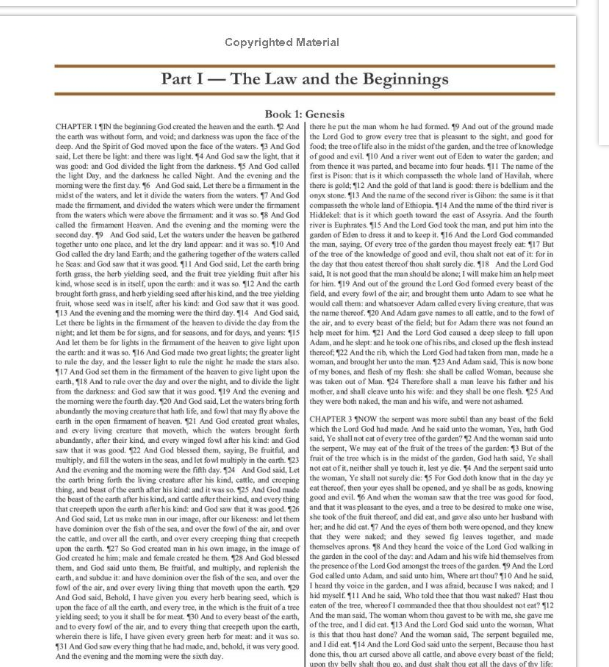
Before we get to the contents, look at the text itself. This is a screenshot from Amazon's own "Look Inside" preview of the paperback:
And here is what the actual body text looks like up close:
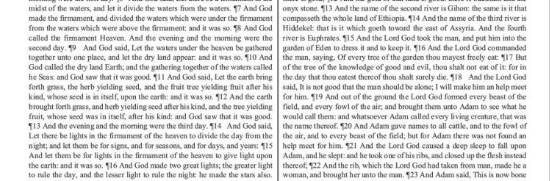
Look carefully at the text. The paragraph symbols from the digital source file are printed on the page. Those marks are invisible formatting characters that tell a word processor where a paragraph ends. They are never supposed to appear in a finished document. They appear here because nobody bothered to open this file and look at it before sending it to the printer. This is a lazy copy-and-paste job. The text was grabbed from a digital source, dumped into a page layout, and shipped to print with the hidden formatting characters still visible on every page. People paid money for this.
Did the publisher even read a single page of their own book? The evidence says no. This is not a formatting choice. This is not a stylistic decision. This is a product made by someone who could not be bothered to look at what they were selling.
The buyers noticed. Here is a sample from the one-star reviews, which account for 10% of the book's 619 ratings:
★ (1/5)
"Very microscopic letters. Definitely need a magnification method of some kind to even read the text. I don't recommend this item, the lettering in the text is EXTREMELY small!"
Verified Purchase, May 2026
★ (1/5)
"The font size is way too small to read even with a magnifying glass! No joke, this book is a waste of money, time and energy. I really wished I would have taken heed to the previous reviews that said the font was too small!"
Verified Purchase, January 2026
★ (1/5)
"This book came to me damaged. Bent covers, I got the hardcover edition, and the front was ripped where the cover meets the spine. Also the print is really small. Like REALLY REALLY small."
Verified Purchase, March 2026
Twelve hundred pages of scripture compressed into 512 pages of two-column text. The math is simple: they made the text unreadably small to keep the page count (and printing cost) down. The listing describes this as "Crafted to Last" and "designed with care, clarity, and reverence."
The Book Count
The listing claims 88 books. The Ethiopian Orthodox Tewahedo Church recognizes 81 books in its broader canon. There is no 88-book Ethiopian canon. The number does not correspond to any recognized tradition.
So where do the extra books come from? Look at the table of contents:
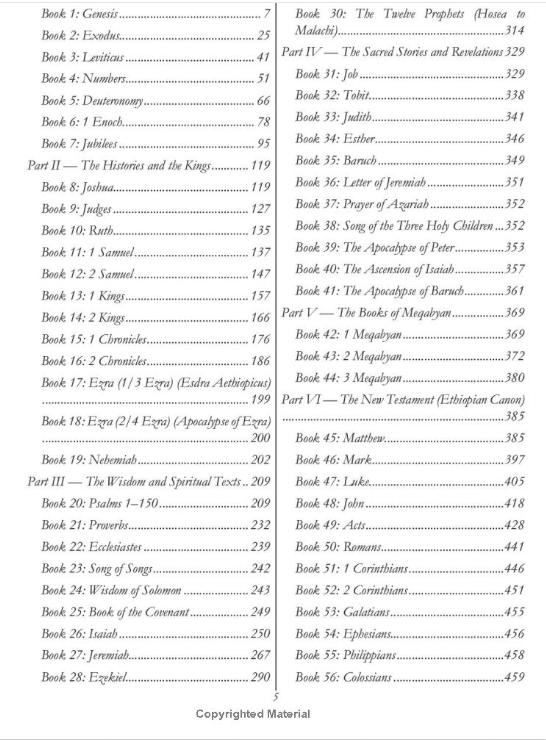
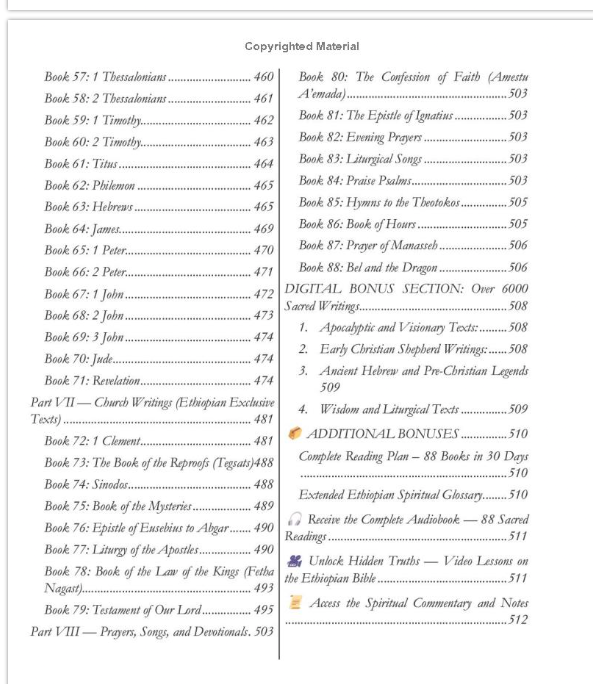
The table of contents reveals the padding. Under "Part VII: Church Writings (Ethiopian Exclusive)" we find:
| Their Book | In the Ethiopian Canon? |
|---|---|
| 1 Clement | No. Qalementos (Ethiopic Clement) is a completely different text. 1 Clement is a Greek letter to the Corinthians. Qalementos is an Ethiopic apocalyptic work that has nothing to do with it. |
| Book of the Reproof (Teguat) | Tegsat is a legitimate canonical book (Proverbs 25-31 in the Ethiopian division). |
| Sinodos | Listed as one book. The Sinodos is actually a collection containing Sirate Tsion, Te'ezaz, Abtilis, and Gitzew. Listing it as a single book obscures four separate canonical texts. |
| Didascalia | Yes, this is canonical. |
| Epistle of Eusebius to Abgar | No. This is a piece of early church correspondence. It is not part of the Ethiopian canon. |
| Liturgy of the Apostles | No. This is a liturgical text. It is not a canonical book of scripture. |
| Book of the Law of Kings (Fetha Negast) | No. The Fetha Negast is a medieval legal code. It is an important Ethiopian text. It is not a book of the Bible. |
| Testament of Our Lord | This is the Syriac Testamentum Domini. The Ethiopian canon contains the Mashafa Kidan (Book of the Covenant), which is a related but distinct text with different content. |
So: non-canonical texts padded in, canonical texts collapsed or missing, and a final count that matches no recognized tradition. The number 88 exists because it looks impressive in a listing title.
What's Actually Missing
Now look at what the Ethiopian canon actually requires and what this edition does not contain:
- Qalementos (Ethiopic Clement): Missing entirely. They substituted 1 Clement, which is a different text from a different tradition in a different language.
- Mashafa Kidan (Book of the Covenant): Missing. They included the Syriac Testament of Our Lord instead, which is a related but distinct text.
- Sirate Tsion: Not listed separately. Presumably buried inside "Sinodos" but there is no way to verify from the table of contents.
- Te'ezaz: Same problem.
- Gitzew (Apostolic Canons): Same problem.
- Josippon (Zena Ayhud): Not listed anywhere in the table of contents.
These are not obscure appendices. They are the books that make the Ethiopian canon the Ethiopian canon. Any edition that omits them and calls itself "complete" is, by definition, not.
The "6,000+ Rare Apocryphal Texts"
The listing's most impressive-sounding claim is the "Digital Vault" containing "6,000+ Rare Apocryphal Texts." The table of contents reveals what this actually is:
- Apocalyptic and Visionary Texts
- Early Christian Shepherd Writings
- Ancient Hebrew and Pre-Christian Legends
- Wisdom and Liturgical Texts
These are public-domain text collections available for free from Project Gutenberg, Internet Archive, and dozens of other repositories. They have nothing to do with the Ethiopian Bible. They are generic pseudepigrapha and apocrypha dumps, packaged as "exclusive" bonuses to inflate the perceived value of the listing. Anyone with an internet connection can access the same material in five minutes.
The same applies to the "88 MP3 Audio Files" (text-to-speech), the "Exclusive Video Lessons" (unlisted YouTube content), and the "Spiritual Commentary via QR Code." These are low-cost digital add-ons designed to make the offer look enormous relative to competitors. They do not add scholarly or textual value.
The Author Portrait
The Amazon author page for this edition carries a photograph: an older Ethiopian man in a pale collarless shirt, looking directly at the camera, seated in front of a wall of Ge'ez script.
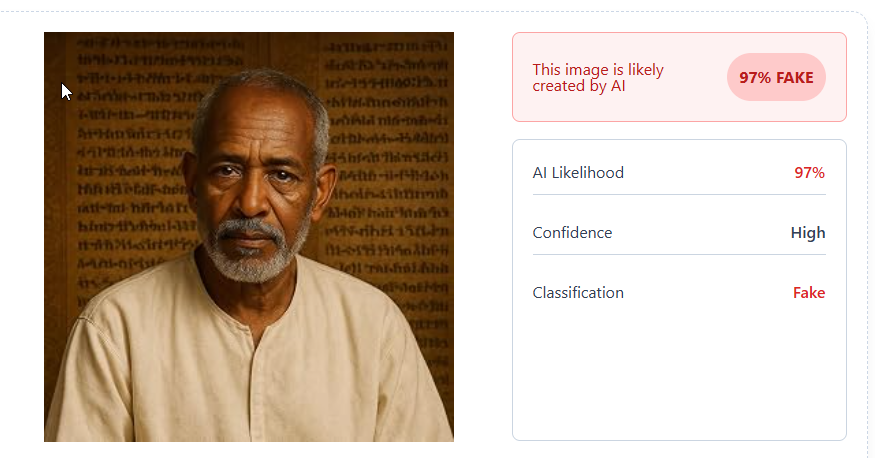
Detection tools are probabilistic. They return false positives, and a score on its own settles nothing, so we will not rest anything on the 97%.
Look at the wall behind him instead.
Image generators cannot write. They produce shapes that carry the rhythm and texture of letterforms without spelling anything, which is why generated images fall apart the moment you try to read the text in them. The background of this portrait is dense with Ge'ez, and Ge'ez is a script with 200 or so characters that almost no training set covers well.
We do not read Ge'ez, so we are not going to tell you what that wall says. We will say that of all the backgrounds available for a portrait meant to establish authority over the Ethiopian canon, a wall of text is a bold one to choose.
If you read Ge'ez, we would like to hear from you. You can settle this in about a second and we cannot settle it at all. Tell us what that wall says and we will print the answer here, whichever way it comes out. If it turns out to be genuine script, correctly set, we will say so on this page and strike the point.
Whether the portrait was generated or licensed from a stock library, the conclusion is the same and it is the only one we need: it is not a photograph of an author. Our checklist explains how to run this test, and the two others that go with it, on any edition you are considering.
The Biography
The portrait is only half of it. Here is the author biography from the same page, in full:
Kwame Elias Obadiah is a devoted scholar of ancient African spirituality and a lifelong student of the Ethiopian Orthodox tradition. Born into a family with deep roots in the African diaspora, he has spent decades recovering, studying, and curating sacred texts that were hidden, fragmented, or misunderstood by Western religious history.
Driven by the call to restore Africa's original voice in the biblical narrative, Obadiah has worked to assemble the most complete English edition of the Ethiopian Bible ever printed. His approach is not merely academic, it is devotional. With reverence and spiritual clarity, he has brought together 88 canonical books and over 6000 rare writings that honor the unbroken spiritual line from Ethiopia's monasteries to today's seekers.
Through The TRUE Ethiopian Bible, Obadiah offers not just a book, but a path, a return to the divine truths once buried by time, colonization, and censorship.
Author biography, Amazon author page
Read it again and notice what is not in it.
There is no university. No degree. No department, no monastery, no teacher, no seminary. No published paper, no prior translation, no edition he worked on before this one. No year he began, no country he studied in, no language he reads. "Decades" appears without a starting point. "Born into a family with deep roots in the African diaspora" describes several hundred million living people and commits to nothing about any of them.
That is not an accident of style. Every sentence in the first paragraph is built so that it cannot be checked. Which is exactly the problem, because the two sentences that can be checked are both wrong.
The Ethiopian Orthodox Tewahedo Church recognizes 81 books. The bio says 88. There is no 88-book Ethiopian canon, and a lifelong student of the tradition would be the last person on earth to get that number wrong. And "the most complete English edition of the Ethiopian Bible ever printed" is a claim about a 512-page book, against a canon of roughly 1.2 million words, which we did the arithmetic on further up this page.
The "over 6000 rare writings" are the digital vault. They are public domain files.
We searched for him. There is no published scholarship, no academic affiliation, no conference paper, no prior translation, no institutional post and no earlier edition attributed to a Kwame Elias Obadiah in Ethiopian studies, Ge'ez, or biblical translation of any kind. Outside the Amazon listing and the pages selling it, the name returns nothing.
Recovering and curating sacred texts across several decades is a career. Careers leave records: a supervisor, a library card, a citation, a colleague, an argument with somebody. We could not find one. We are not going to tell you what that means. We are telling you what we looked for and what was there.
About That Last Paragraph
One part of this deserves to be taken seriously rather than mocked, because the history it reaches for is real.
Ethiopian sacred literature genuinely was neglected by Western scholarship. Texts that the Ethiopian church preserved continuously for fifteen centuries went untranslated, uncatalogued and unread outside Ethiopia for a very long time, and some of the reasons for that were exactly as ugly as you would expect. A reader who feels that absence is responding to something true.
Which is what makes the last paragraph of that bio hard to read charitably. It invokes colonization and censorship to sell a 512-page volume that omits most of the canon it claims to restore, misstates the number of books in it, and routes its headline feature through a QR code. The grievance is real. The book is not the remedy, and the people most likely to be moved by that paragraph are the people least likely to be served by what arrives.
The Ethiopian canon does deserve a complete English edition. That is why we made one, and why our sources page lists every book in it with the translator, the date and the language it came from, so that nobody has to take our word for anything either.
The Pattern
This edition is not unique. It is one example of a pattern that the Ethiopian Orthodox Bible Project identified in 2025: books with inflated titles, contrived author names, missing content, unreadable formatting, and no honest accounting of what is inside.
The pattern works because most buyers do not know what the Ethiopian canon contains. They search for "Ethiopian Bible," they see a listing that says "complete" and "88 books" and "TRUE," and they trust it. They do not know that 1 Clement is not Qalementos. They do not know that the Fetha Negast is a legal code, not scripture. They do not know that squeezing 1,200 pages of text into 512 pages means the type will be too small to read.
They find out when the book arrives.
What a Real Ethiopian Bible Requires
The Ethiopian Orthodox Tewahedo canon contains 81 books. They fall into four groups:
- Old Testament (54 books): The standard OT, plus deuterocanonical books (Wisdom, Sirach, Baruch), plus texts unique to the Ethiopian tradition (Jubilees, 1 Enoch, 1-2-3 Meqabyan, Ezra Sutuel, and others).
- New Testament (27 books): The same 27 books recognized by all major Christian traditions.
- Books of Church Order (8 books): Sirate Tsion, Te'ezaz, Gitzew, Abtilis, the 1st and 2nd Mashafa Kidan, Qalementos, and the Didascalia. These are the texts that most distinguish the Ethiopian canon from all others.
A complete edition needs to account for every one of these books with identified sources, documented provenance, and readable formatting. It needs to be honest about which texts come from the Ge'ez and which come from related traditions. It needs to tell you who translated what and when.
The bar is not impossibly high. It just requires treating the Ethiopian biblical tradition as something worth doing properly.
We are building a different kind of edition. Every source is named. Every editorial decision is recorded. Every book's provenance is documented on our Sources & Methodology page. Nothing is copy-and-paste: every archaic source was rephrased into modern English so you can actually read it. We think the Ethiopian canon deserves better than what it has been getting, and we are trying to prove that with the work itself.