We have now taken four English editions of the Ethiopian Bible apart on this site. Different publishers, different prices, different page counts, different years. Reviewing them one after another produces an odd feeling, which is that you are reviewing the same book four times.
Same claim on the cover. Same number. Same bonus. Same missing books. Same mistake in the same place in the table of contents.
This post is about why, and the answer is more interesting than "they are all scammers." It is a specific and very ordinary thing that happens in publishing, and there is a clean line running through the middle of it.
Two Publishers, One Cover
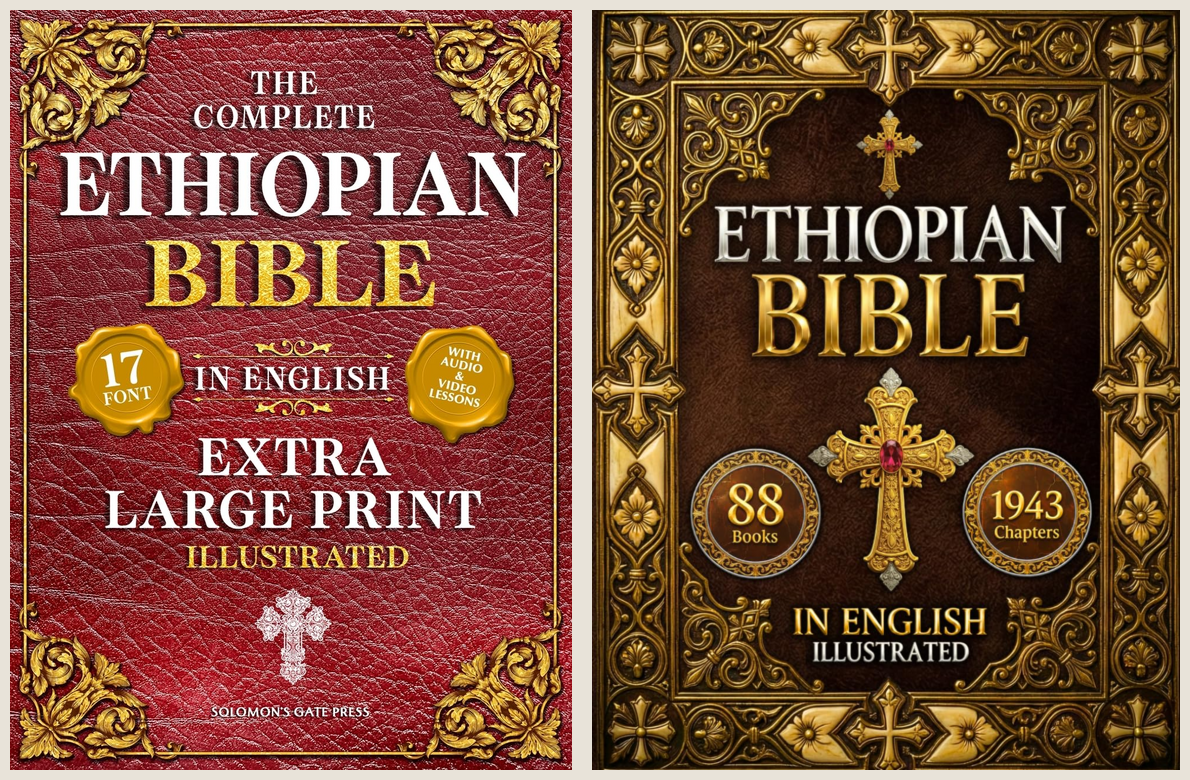
Look at what these two have in common. A leather texture. A heavy gold scrollwork frame with ornamented corners. The word ETHIOPIAN in white above the word BIBLE in gold, split the same way across two lines with the same colour change at the same point. Gold seal medallions carrying numeric claims, flanking an ornate cross. "IN ENGLISH." "ILLUSTRATED."
That is not a coincidence and it is not, by itself, wrong. Which brings us to the actual distinction.
Everybody Studies the Bestsellers
Here is how a book gets planned, at our house and at every other one.
You find demand. You look at what is already selling in the category and you study it closely: the covers, the titles, the subtitles, the price points, the way the listing is written, which promises appear above the fold. You are trying to learn what this particular audience responds to, and the fastest way to learn it is to look at what they have already bought.
We do this. We did it for the edition we sell. Anyone in publishing who tells you they do not is either lying or losing money.
Studying the market is not the problem. Cover conventions are conventions for a reason: a reader scanning a results page needs to recognise the category in about a fifth of a second, and a gold frame on leather says Bible faster than anything else available. Nobody owns that.
The two processes are identical right up to a single question, and then they separate completely.
One of them asks what is selling? and stops, because that is enough to ship a product.
The other asks what is selling, and what is wrong with it?
Everything else follows from which of those two questions you stop at. The first produces a template. The second produces a book.
Shared Errors
There is a way to tell which one you are holding, and it is a method borrowed from the study of the very texts these editions claim to contain.
When scholars want to know whether one manuscript was copied from another, they do not look at what the two have in common. Two accurate copies of the same text are identical everywhere, and that tells you nothing. They look for shared errors.
A scribe working from an original makes his own mistakes. A scribe copying another scribe inherits his mistakes, and adds a few. So when the same wrong reading appears in six manuscripts, that is not six independent errors. It is one error and five copies, and the pattern of shared mistakes lets you reconstruct which came from which. This is how the family trees of ancient texts are built, and it works because errors are much better evidence than accuracy is.
Point that method at a page of Amazon listings and it works just as well.
The Shared Error: The 88
The Ethiopian Orthodox Tewahedo Church recognises 81 books. Forty-six in the Old Testament, thirty-five in the New. The number is not in dispute, it is not a matter of scholarly tradition, and it is not hard to find.
There is no 88-book Ethiopian canon.
There never has been.
The number appears to come from adding the 66 books of a Protestant Bible to 22 apocryphal texts, which produces a smaller canon reaching a larger number, and has nothing to do with Ethiopia at all.
Now count how many editions print it. It is on the cover of the bestseller. It is on the cover of the 271-page hardcover. It is in the author biography of a third. It is in the listing copy of a fourth.
Four publishers did not independently invent the same wrong number for the same canon. A wrong number has no natural source. Anyone who went to a source would have found 81, because 81 is what every source says. The 88 can only have come from another listing, which is the definition of a shared error, and it is the single most useful fact in this entire category.
It is also the reason a buyer can perform this whole analysis without owning a single one of these books. If the cover says 88, the publisher did not check. Nothing else about the edition needs to be examined to know that much.
Why Everybody Has a Digital Vault
Every fake Ethiopian Bible we have examined includes a bundle of extra files delivered after purchase. The scale of the promise varies and the mechanism does not: a QR code, a download, a members area.
One promises 1,801 sacred books. One promises 6,000 rare apocryphal texts. One promises audio and video lessons. One promises additional sacred texts including the Book of Adam and Eve.
These are public domain files. The Book of Adam and Eve has been free online for decades, and so has everything else in these bundles. The offer is not a service, it is a number that sounds enormous next to a page count that is not.
This one is not a shared error, and it is worth being precise about the difference. Nobody got anything wrong here. There is no fact to check, no source to consult, nothing to inherit incorrectly. The vault is a feature, and every publisher in the category added one for the same reason: they are competing on numbers.
Once one listing advertises 1,801 sacred books, the next one cannot simply not have a vault. It is now a column in the comparison, and an empty column looks like a worse product. So the number goes up. Six thousand. Audio. Video. A members area. Each addition costs its publisher an afternoon and adds nothing at all to the book, which is the point: it is cheap to escalate, and expensive to actually improve a text.
We could do this tomorrow. Assembling a few hundred public domain files into a zip and putting a QR code in the back matter is genuinely trivial, and it would let us print a much larger number on our own cover.
We have not, and we are not going to. Not out of principle exactly, but because it would mean competing with these editions on the thing they are good at. They win on statistics. Anyone can win on statistics, which is why nobody in this category is winning anything else. We would rather compete by selling the product people are actually paying for, which is the Ethiopian canon, in English, between two covers.
The vault does not prove anyone copied anyone. It proves what the category decided to compete on.
The Second Kind of Error: Nobody Looked It Up
The 88 is a shared error in the strict sense: the same wrong number, identically, in listing after listing. The next one is not quite that. It is a whole category of error, and it shows up differently in every edition, which is in some ways worse.
The category is: nobody established what is actually in the Ethiopian canon before printing a book claiming to contain it.
Take the clearest example. The Ethiopian canon contains Qalementos, a Ge'ez apocalyptic work in seven books, translated into French by Sylvain Grebaut across the Revue de l'Orient Chretien between 1911 and 1928. 1 Clement is a Greek letter written from Rome to Corinth around the year 96. They share four letters in English and nothing else: different author, different language, different content, different purpose, different millennium.
Several editions in this category list 1 Clement where Qalementos belongs. One lists 1 and 2 Clement both, which compounds it, since 2 Clement is an anonymous Greek homily with no connection to Ethiopia whatsoever. That is what happens when somebody searches for "Clement," takes the first result, and moves on.
But the same failure surfaces in other forms across these books, and cataloguing them is more revealing than any single instance:
- Printing an Old Testament translated from the Hebrew Masoretic Text. The Ge'ez Old Testament descends from the Greek Septuagint. This is the first thing you learn about the Ethiopian Bible, and getting it wrong means the base text is from the wrong tradition entirely.
- Listing the Shepherd of Hermas as canonical, split into three books to help reach 88. It is a second-century Roman text and it is not in the Ethiopian canon.
- Listing Sinodos as a single book, which hides the four canonical texts inside it, or as four unnamed numbered volumes, which is the same failure from the other direction.
- Printing Kidane Mehret, the Covenant of Mercy, a Marian devotion, in place of Mashafa Kidan, the Book of the Covenant, which is the actual Church Order text.
- Confusing the three Meqabyan, which are unique to Ethiopia, with the Maccabees of the Catholic deuterocanon, which are unrelated books that merely sound similar.
- Omitting Esther, Ezra and Nehemiah from a contents list advertised as complete. Those are in every Bible in Christendom.
One of those deserves a fair hearing, because there is a version of it that would be defensible. If an edition printed the whole Ethiopian canon and then added the Shepherd of Hermas, or 2 Enoch, or a few other early texts, clearly labelled as extras, we would have very little to say about it. Publishers make editorial choices about what to include alongside a canon, readers benefit from more material rather than less, and an appendix of related literature is a perfectly honest thing to sell.
That is not what is happening. In these editions the extra material is not sitting beside the canon, it is standing in for it. One of them lists 22 texts, mostly apocrypha, of which exactly one appears in an ordinary Bible, and calls the result the complete Ethiopian Bible. Another counts a Roman text three times to reach a number while omitting Esther. The additions are not generosity. They are what got printed instead of the books the cover promised.
A collection of assorted apocrypha is a legitimate product with a legitimate audience. It is simply not an Ethiopian Bible, and the only reason to call it one is that "Ethiopian Bible" is what people are searching for.
No two of those are the same mistake. That is the point. If they were all copying one bad contents list you would expect one consistent set of wrong books, and instead you get six different ways of not knowing.
What is shared is not the error. It is the absence of the step that would have caught it. Every one of these is what an hour with a reference work prevents, and nobody in this category spent the hour, because the template did not require it. The cover sells the book. The contents page is just something that has to be there.
None of which would matter very much on its own. Anyone can be wrong about a canon most people have never heard of, and a compiler who put out a book of apocrypha and described it as exactly that would owe nobody an apology.
The trouble is what these listings claim while being wrong. One is sold as the work of "biblical scholars." One credits "the biblical scholar Edward Jones." One describes its author as a lifelong student of the Ethiopian Orthodox tradition who has spent decades recovering and curating sacred texts. That is the claim being made at the moment the buyer decides.
And the thing they got wrong is on the first page of a Google search. The Ethiopian Orthodox Tewahedo Church recognises 81 books; you do not need Ge'ez, an archive, or a decade of study to find that out, you need about forty seconds. A claimed authority who has not spent the forty seconds is making two statements at once, and only one of them is on the cover.
What the Template Skipped
Here is the part that should bother anyone who works in publishing, because it is not just dishonest. It is bad business.
Every one of these editions has one-star reviews. Nineteen percent of one bestseller's ratings are one star. Ten percent of another's. And those reviews are not vague expressions of disappointment. They are specifications.
The tiny type font looks like 6 pt or smaller, and each page is just a wall of text.
It is not the full complete Bible. It only has the 22 books.
This version of the Ethiopian Bible is incomplete and a great deal of the Bible is missing.
You either get what you order and you can't read it or you can read it, but you don't get what you order.
Read those as a publisher rather than as a shopper. Every one is a feature request. Set the type larger. Include the whole canon. Break the paragraphs. Say honestly what is inside. They are free, they are public, they are written by people who already spent money in this category, and they were sitting there the entire time.
Nobody answered them. The publishers who cloned the covers of the bestsellers had those reviews on the same screen as the covers they were copying, and they copied the cover.
That is the whole thesis. One of these processes is marketing, which is the study of a market in order to serve it better than the incumbent does. The other is templating, which is the study of an incumbent in order to reproduce it more cheaply. They look identical for the first several steps, and they diverge at the point where somebody either does the work or does not.
The Author Photos Are Not Part of the Template
One thing worth separating out. Two of these editions have author portraits that do not belong to their authors: one a stock photograph of a working model whose face appears across several libraries, one returning a 97% likelihood of having been generated, complete with a biography containing not a single checkable fact.
Those are not cloned from a competitor. They are what happens at the end of the process, when the book is assembled and the listing needs a person attached to it, and the cheapest way to produce one is to make one up. It is the last item on a checklist rather than a strategy.
We have written separately about how to check an author portrait yourself, which takes about five seconds and works on any book in any category.
What We Copied
It would be convenient to end there, so we will not.
We studied the same bestsellers. We looked at their covers and noted that gold and dark leather signal scripture in this category, and our cover is dark with gold lettering, because that convention exists for a reason and ignoring it would have been vanity rather than integrity. We read their listings and learned which promises buyers respond to. We looked at their prices before setting ours.
What we did not copy was any fact. We counted the books ourselves and got 81, printed as 90 volumes because the Ethiopian reckoning groups several together, and we explain that difference every time both numbers appear. We went and found a defensible English source for each one and named it, with the translator, the date and the original language, on our sources page and in the book. Where no good source exists, we say so: our Josippon is a reconstruction rather than a translation from the Ge'ez, and it is labelled as one everywhere it appears.
We also do not claim to be biblical scholars, and you will not find the phrase anywhere on this site or in the book. We are a publisher. What we did was editorial work: establish what belongs in the canon, find the best available public domain translation of each book, name it, and rephrase archaic English into modern prose so the thing can be read. The scholarship is Brenton's and Charles' and Horner's and Harden's and Grebaut's. The voice is ours. Those are different jobs and we are only claiming one of them.
And then we read the one-star reviews of every competing edition, and built the book those reviewers were asking for. Three columns so 1.2 million words fit in a volume that can actually be manufactured. Every verse its own paragraph. All eight Books of Church Order, because their absence was the most common complaint in the category. A free sample of the real interior, so nobody has to trust the cover.
Our Own Scoreboard
The honest test of whether that worked is not what we say about ourselves. It is what buyers say after the book arrives.
You do not have to take our word for that, and you should not. Amazon publishes the star breakdown on every listing it sells, including ours. The two editions discussed above sit at 19% and 10% one star. Go and look at ours before you believe anything on this page.
We do collect them. At that volume it would be strange not to: some readers want a different translation philosophy, some wanted large print, some received a damaged copy. That is the cost of selling books to strangers, and a publisher claiming a perfect record is a publisher you should check on.
But the gap between "a few" and "one buyer in five" is not a difference of luck. It is the difference between answering the complaints and inheriting the template that caused them.
What This Means If You Are Buying
You do not need any of this analysis to protect yourself. You need one number.
If the cover says 88 books, the publisher did not check what is in the Ethiopian canon. Everything else on this page follows from that, and you can see it before you click.
Beyond that: multiply the page count by a realistic words-per-page figure and see whether it reaches seven figures, because the canon is about 1.2 million words. Open the table of contents and look for Sirate Tsion, Te'ezaz, Gitzew, Abtilis, the Didascalia and Qalementos. Check that Esther is in there. Our full checklist has the rest, and our wall of shame has every edition we have scored against it, including our own.
Run the tests on ours too. That is rather the point.