Start with the answer to the question most people arrive with: no, the Bible was not decided at the Council of Nicaea. Nicaea, in 325 CE, argued about the nature of Christ. The canon was never on its agenda. There was no council, ever, where church leaders sat down with a pile of candidate books and voted the Bible into existence.
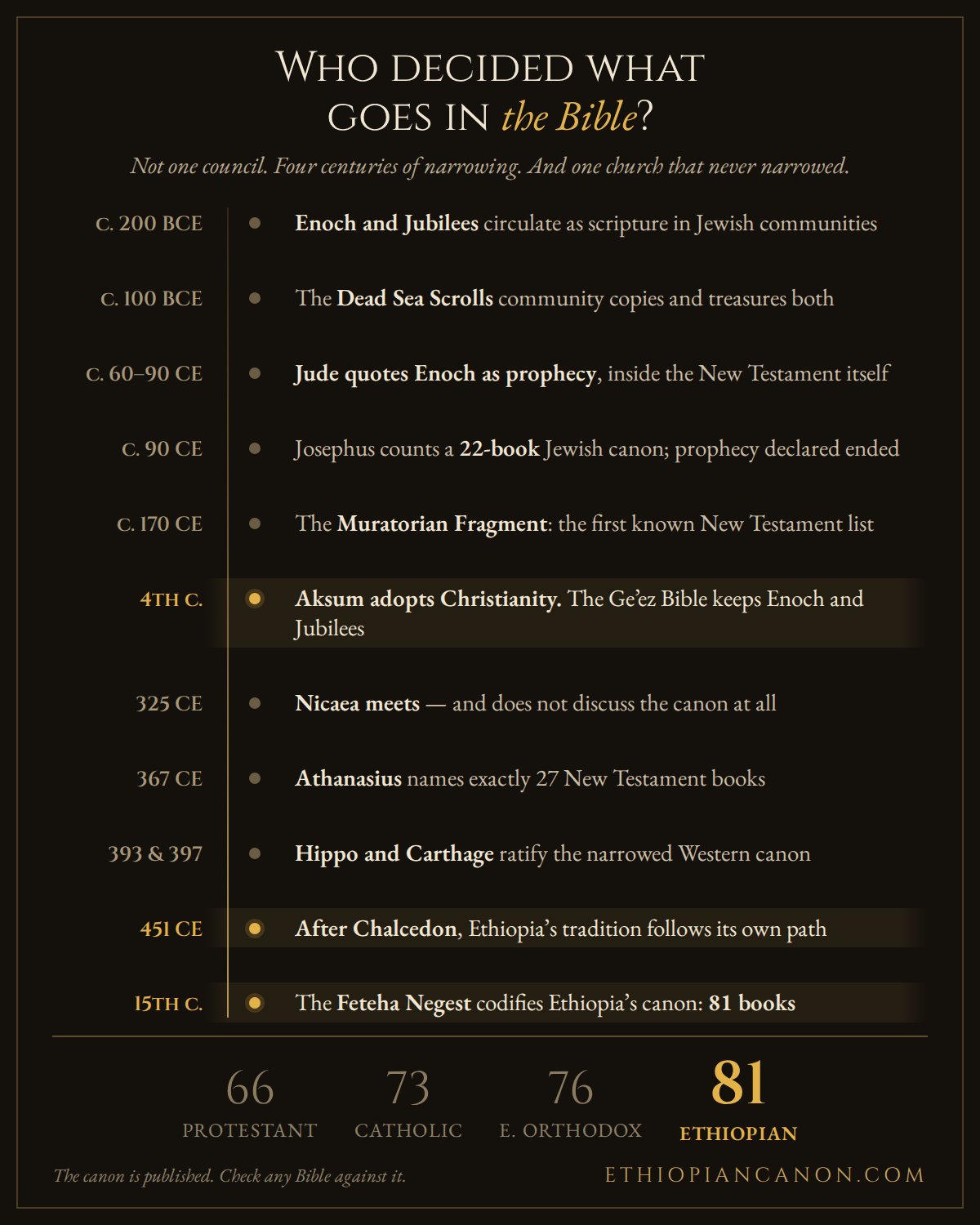
What actually happened took about four hundred years, and it helps to begin with what the Bible is. It is not a book. It is a library: dozens of separate works, written by different authors in different languages across more than a thousand years, which circulated as individual scrolls long before anyone bound them together. Ask how many books that library holds and you get four different answers, all of them called "the Bible": Protestants count 66, Catholics 73, Eastern Orthodox around 76, and the Ethiopian Orthodox Tewahedo Church 81.
Key Concept
The Bible is not one book. It is a library of books. Once you lock that in, a lot of common misconceptions disappear on their own.
How the Narrowing Actually Happened
The Jewish scriptures settled first. By the first century CE the Hebrew Bible had largely taken its present shape, and around 90 CE the historian Josephus described a 22-book canon and declared that prophecy had ceased centuries earlier. That declaration mattered: it drew a line that left younger books, however loved, on the outside.
The Christian side took longer. Paul's letters were written in the 50s and 60s CE, the Gospels between roughly 70 and 100. The earliest known attempt at a New Testament list, the Muratorian Fragment of about 170 CE, already includes most of the familiar books, and already rejects one popular text, the Shepherd of Hermas, for being written "quite recently, in our times." Around 320 CE Eusebius was still sorting Christian books into accepted, disputed and rejected, with James, Jude, 2 Peter and Revelation sitting in the disputed pile.
Three criteria did the sorting, applied flexibly rather than mechanically. Was the book written by an apostle or an apostle's associate? Did it agree with the teaching the churches had received? Was it read widely, across many communities, rather than in one region? Books that had earned their place in worship over generations passed; books that were loved but late, or orthodox but local, did not.
The decisive document came in 367 CE, when Athanasius of Alexandria listed exactly the 27 New Testament books in his Easter letter and instructed that only these be read as scripture. The councils of Hippo (393) and Carthage (397) ratified the list. Athanasius's letter also ordered non-canonical books destroyed, and its most lasting side effect may be archaeological: the monks near Nag Hammadi appear to have buried their library rather than burn it, sealing thirteen codices in a jar that a farmer's mattock found in 1945.
The Book That Almost Made It
No excluded text came closer than 1 Enoch. It circulated as scripture in Jewish communities two centuries before Jesus. More than twenty copies were found among the Dead Sea Scrolls, more than most biblical books. Tertullian defended it as inspired around 200 CE. And the New Testament itself quotes it: Jude 14–15 cites Enoch by name as prophecy, quoting 1 Enoch 1:9 nearly word for word.
It fell out of the Western canon anyway: its elaborate angelology unsettled fourth-century church leaders, it was absent from the Greek Bibles most Christians used, and the scholars whose opinions carried the day were against it. How the Ethiopian church reads Enoch is its own story; the short version is that Ethiopia never faced the question of readmitting it, because Ethiopia never set it aside.
The Church That Never Narrowed
The kingdom of Aksum adopted Christianity in the fourth century, while the Western canon debates were still live, and the Bible translated into Ge'ez kept what the West was in the process of setting aside: Enoch, Jubilees, and more. After the Council of Chalcedon in 451, the Ethiopian tradition followed its own path, and its canon was eventually codified in the Feteha Negest at 81 books: 46 Old Testament and 35 New, the standard 27 plus the eight Books of Church Order.
The result produced one of history's better ironies. When European scholars brought Ge'ez manuscripts of Enoch back from Ethiopia in the 1770s and announced the recovery of a long-lost ancient text, they were describing a book that tens of millions of Ethiopian Orthodox Christians had been hearing read as scripture, continuously, for well over a thousand years. Nothing was lost. One tradition had simply kept the receipts.
Key Concept
"Lost books" describes one tradition's choices, not texts vanishing from the earth. A book can be apocrypha in Rome and scripture in Aksum at the same time.
That canon is not folklore. It is published, division by division and book by book, and any Bible sold under the Ethiopian name can be checked against it: the complete 81-book list, with every source we used to render it in English. You can also read the whole canon free online.
Questions People Actually Ask
Was the Bible decided at the Council of Nicaea?
No. The Council of Nicaea in 325 CE addressed whether Christ was of the same substance as the Father. The biblical canon was not on its agenda at all. The first list of exactly the 27 New Testament books appears in Athanasius's Festal Letter of 367 CE, ratified by the regional councils of Hippo (393) and Carthage (397).
Was the Bible really written decades after Jesus's death?
The New Testament, yes. Paul's letters date to the 50s and 60s CE, the four Gospels to roughly 70 to 100 CE. The canon took far longer: about 335 years separate the crucifixion from the first complete list of the 27 books, longer than the United States has existed.
Who actually chose the books of the Bible?
No single person or council. Scattered communities used, copied and read certain texts in worship for generations, and church leaders later formalized that consensus using three flexible criteria: apostolic origin, agreement with received teaching, and breadth of use. Different communities reached different answers, which is why four different canons exist today.
Why was the Book of Enoch removed from the Bible?
It was never removed everywhere. 1 Enoch circulated as scripture in Jewish communities, survives in more than twenty copies among the Dead Sea Scrolls, and is quoted as prophecy in the New Testament book of Jude. Western churches set it aside by the fourth century. The Ethiopian Orthodox Tewahedo Church has held it canonical continuously, and the only complete text survives in Ge'ez.
Which church has the biggest Bible?
The Ethiopian Orthodox Tewahedo Church: 81 books, 46 Old Testament and 35 New Testament, including 1 Enoch, Jubilees, the three books of Meqabyan and the eight Books of Church Order. Protestants count 66, Catholics 73, Eastern Orthodox around 76. The full Ethiopian list is published at ethiopiancanon.com/canon.
Are the 'lost books' of the Bible really lost?
No. Nearly all of them exist in modern translations. 'Lost' describes one tradition's choices, not texts vanishing: books like Enoch and Jubilees were never lost to Ethiopia, which kept copying them for over a thousand years. The complete Ethiopian canon can be read free online.
Related reading: