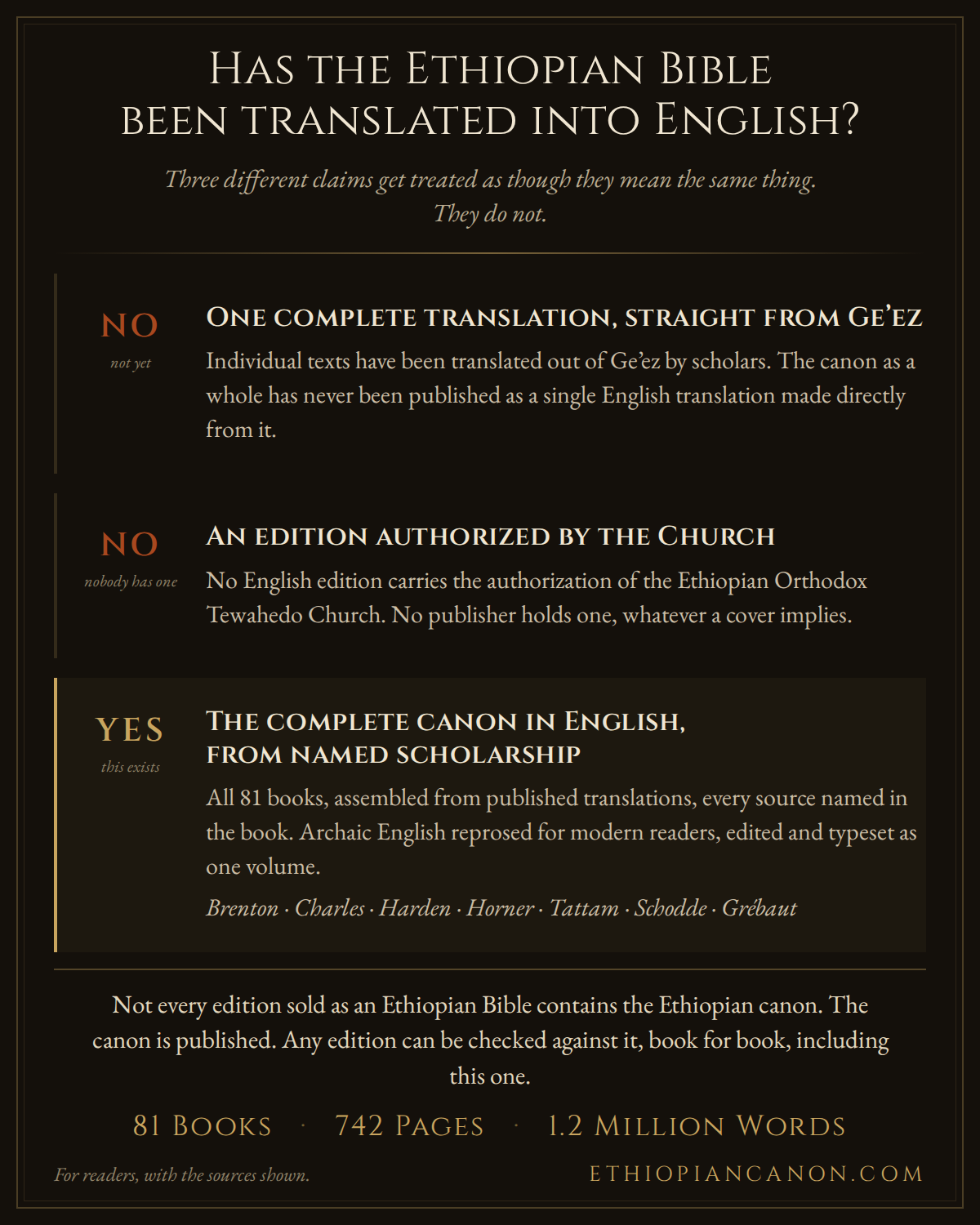
Individual books of the Ethiopian tradition have been translated into English. What does not currently exist is a single, widely available translation of the complete Ethiopian Orthodox canon, made directly from Ge’ez, and officially authorized by the Ethiopian Orthodox Tewahedo Church.
That one distinction explains most of the confusion around Ethiopian Bibles sold in English.
What Has Actually Been Translated Into English?
Many individual works have legitimate English translations, made by named scholars whose work you can go and check.
R. H. Charles translated 1 Enoch and Jubilees. J. M. Harden translated the Ethiopic Didascalia directly from multiple Ge’ez manuscripts held at the British Museum. Rev. G. Horner translated portions of the Sinodos from the Ge’ez. Prof. George H. Schodde translated the Apostolic Canons from the Ge’ez. Henry Tattam’s 1848 edition of the Apostolical Constitutions gives us the Abtilis, though from the Coptic rather than the Ge’ez. Other Ethiopian church-order texts survive only in scholarly French translations made from Ge’ez manuscripts.
That material was produced by different scholars, working from different source languages, across roughly a century and a half. It is scattered across books, academic journals, public-domain editions and specialist research projects. Our Sources and Methodology page lists every one of them, book by book.
Some parts of the canon remain especially difficult. No public-domain European-language translation of the Ethiopian Josippon is presently available. Other texts have English translations, but a specialist preparing a new critical edition might make different choices in individual passages.
So the problem is not the one people assume. Choosing between the NIV, the ESV and the KJV means choosing between complete English translations of a familiar collection of books. The Ethiopian canon contains works whose translation histories vary enormously, and some of which have never had a popular English edition at all.
What About the “Complete Ethiopian Bibles” Sold Online?
Most books advertised as a complete Ethiopian Bible in English do not solve this problem. They avoid it.
Some begin with a familiar Western Bible and append Enoch, Jubilees and an assortment of apocryphal works. Others advertise 84, 86 or 88 books without following any recognized Ethiopian enumeration. Many omit the Books of Church Order, the Ethiopian Meqabyan, the Josippon, or the other material that makes the Ethiopian canon distinctive in the first place.
Adding Enoch to a Protestant Bible does not produce the Ethiopian canon. We have taken specific editions apart in detail: what is actually inside “The TRUE Ethiopian Bible”, an edition that sold 50,000 copies, another bestseller, and one that contains no Bible at all. They fail in strikingly similar ways, which is itself worth explaining.
A reader evaluating an English edition should ask a short list of questions:
- What books are actually included, and in what order?
- Does it contain the Ethiopian 1, 2 and 3 Meqabyan, rather than substituting the Greek books of Maccabees?
- Does it include the eight Books of Church Order? Are Sirate Tsion, Te’ezaz, Gitzew, Abtilis, Qalementos, the two Books of the Covenant and the Ethiopic Didascalia all present?
- Does the publisher identify the source used for every single book?
- Does the page count plausibly hold the amount of text being claimed?
A large number printed on a cover answers none of those questions. Our guide to spotting a fake Ethiopian Bible works through each red flag with examples, and the Wall of Shame scores the editions currently on sale, including our own.
What We Produced, and What We Did Not Claim
A disclosure: we publish an English edition of the Ethiopian canon ourselves.
It is a modern-English reading Bible. It is a composite edition, assembled from the best available published sources we could identify. It is not presented as a new critical translation of the entire canon directly from Ge’ez, and it is not presented as an officially authorized English Bible of the Ethiopian Orthodox Tewahedo Church. Nobody has one of those.
We used a source appropriate to each part of the canon. The Old Testament rests primarily on Brenton’s English Septuagint of 1851, because the ancient Ge’ez Old Testament belongs substantially to the Greek textual tradition rather than the Hebrew Masoretic one. The familiar New Testament uses the World English Bible, whose English was already accessible and so did not need our modernization.
For the canon-specific works we used named scholarly or published sources: Charles for Enoch and Jubilees, Horner for portions of the Sinodos, Harden for the Ethiopic Didascalia, Schodde for the Apostolic Canons, Tattam for the Abtilis, and French scholarly translations from the Ge’ez for works such as the Mashafa Kidan and the Qalementos.
Our Meqabyan text uses the English translation published through Wikisource. That is identified explicitly on our website and in the printed edition, and its CC BY-SA 4.0 licence and contributors are credited. We reprosed the English for accessibility while preserving the substance of the translation. It gives ordinary English readers meaningful access to the narratives and teachings of Meqabyan. A specialist preparing a new critical translation from the Ge’ez might phrase individual passages differently, and our edition does not claim otherwise.
The Josippon required something more involved. With no usable public-domain translation of the Ethiopic Josippon available, we built an English approximation of its scope and structure from the Hebrew Sefer Yosippon tradition, comparative scholarship on the Hebrew and Ethiopic recensions, and the portion available directly from the Ge’ez. The edition labels that approach plainly, and we have written up exactly how we did it.
Every source other than the World English Bible was reprosed into readable modern English. That is editorial modernization, and we call it that, rather than quietly implying new direct translations from the original languages. Sources, licences, textual relationships and material limitations are all disclosed.
Why Call It a Reading Bible?
A critical translation and a reading edition do different jobs.
A complete critical translation of the Ethiopian canon directly from Ge’ez would need a major scholarly project: manuscript comparison, textual criticism, language specialists, and consultation with the Ethiopian Orthodox tradition. That project would be genuinely valuable. It does not yet exist as a complete, widely available English Bible.
Our aim was narrower and more immediate: make the canonical material readable now. Most people who want to read Enoch, the Meqabyan, the Books of Church Order and the rest cannot spend years learning Ge’ez, tracking down century-old academic publications, translating French scholarship and reassembling the canon book by book.
English-speaking Christians read the New Testament without first learning Koine Greek. Translation and responsible editorial mediation are how historical texts reach readers who cannot access the source languages. What matters is honest sourcing, careful representation, and clear disclosure of the limits. That is the standard we tried to hold ourselves to, and the full history of the project sets out how we got there.
The result covers the complete canonical scope in readable English, with editorial notes wherever a difference or a limitation needs explaining. You can read the whole thing free online, check the canon list book by book, or see the printed edition.
The Shortest Accurate Answer
Parts of the Ethiopian Bible have been translated directly into English from the Ge’ez. No complete, widely available, church-authorized English translation of the entire canon directly from Ge’ez currently exists. Composite English reading editions can represent the canon honestly, but their credibility depends on what they include, which sources they use, and how openly they describe their methods.
Related reading: