The direct answer first: no original manuscripts of any Old Testament book survive. Every Bible's Old Testament descends from one of two later textual streams. The Septuagint is the Greek translation begun around 250 BCE in Alexandria, and it is the oldest surviving witness to the text by a wide margin. The Masoretic Text is the Hebrew text standardized by the Masoretes between roughly 600 and 1000 CE; its oldest complete manuscript, the Leningrad Codex, was copied around 1008 CE. So the Greek translation, as a surviving text, is centuries older than the surviving Hebrew.
That sounds backwards, and it matters, because the two streams do not always say the same thing.
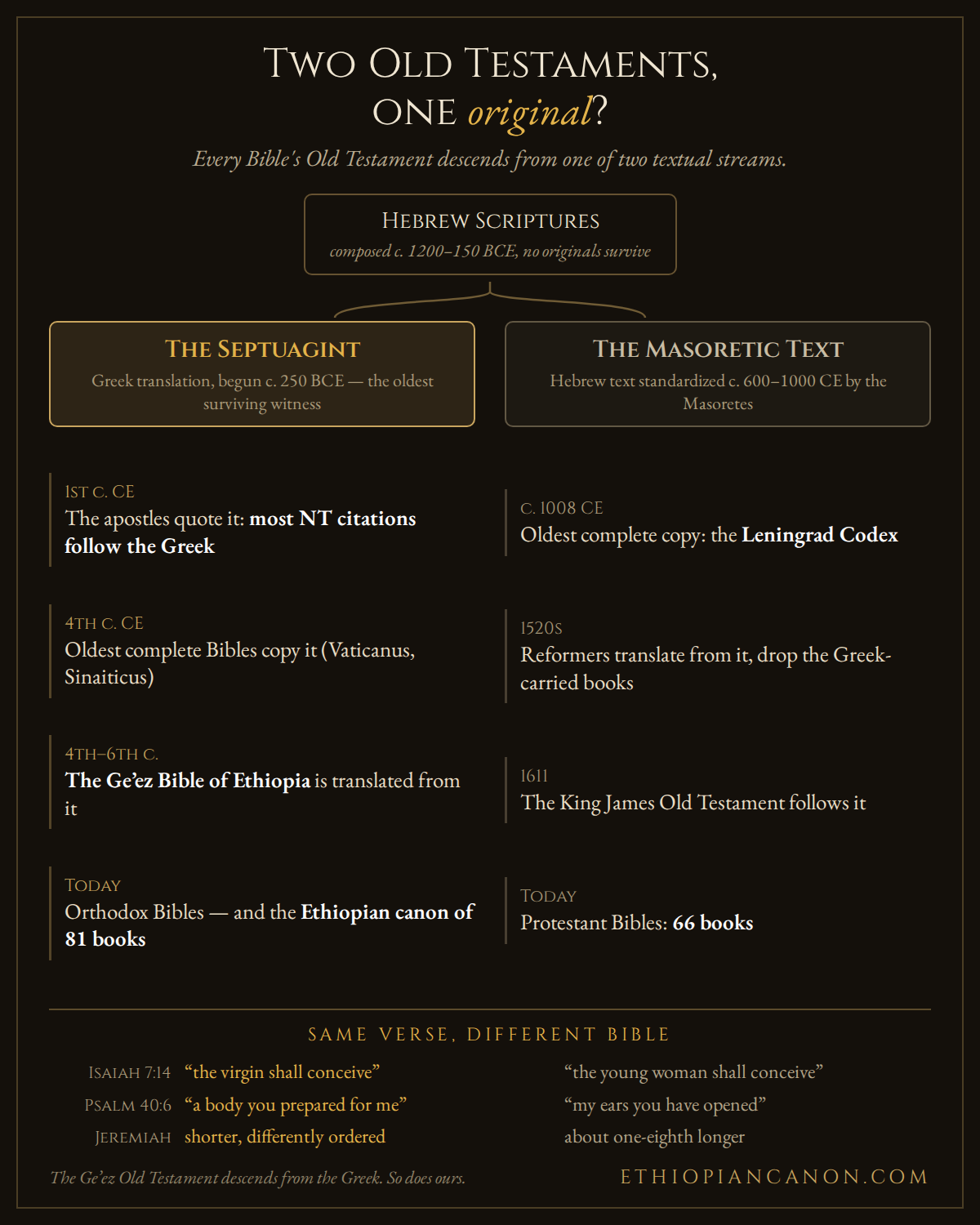
Same Verse, Different Bible
In Isaiah 7:14 the Septuagint reads "the virgin shall conceive," and Matthew 1:23 quotes it that way; the Masoretic Hebrew has "the young woman." In Psalm 40:6 the Septuagint reads "a body you have prepared for me," and the whole argument of Hebrews 10 leans on that wording; the Hebrew has "my ears you have opened." The book of Jeremiah is about one-eighth shorter in the Greek and differently arranged, and fragments of Jeremiah found among the Dead Sea Scrolls agree with the Greek against the later Hebrew. The scrolls settled the old assumption that the Hebrew stream is automatically the original: at Qumran, both streams already existed side by side, in Hebrew, before Jesus was born.
Key Concept
"Older manuscript" and "original text" are different claims. The Septuagint is the older surviving witness; the Masoretic Text is a later standardization of a parallel Hebrew stream. Neither is the autograph, and each preserves readings the other lost.
One Word, Four Doctrines
Why do wording differences matter? Because doctrine grows around vocabulary. The clearest example is the word "atonement" itself, one of the very few theological terms native to English rather than borrowed from Hebrew, Greek or Latin. William Tyndale popularized it in the 1520s, built from the phrase "at onement," the state of being made one. In the King James New Testament it appears exactly once, at Romans 5:11, where the Greek underneath is katallage, which modern translations render "reconciliation." The English name of the doctrine already encodes one particular reading of what the doctrine is.
The famous battleground is Romans 3:25, where Paul calls Christ a hilasterion. The King James rendered it "propitiation," which implies appeasing wrath. The Revised Standard Version of 1952 chose "expiation," the wiping out of sin, with no wrath in view, and set off a real scholarly fight: C. H. Dodd argued the pagan picture of appeasing an angry deity did not fit the Hebrew background, and Leon Morris argued that wrath was exactly the point. The NIV and NRSV settled on the neutral "sacrifice of atonement," and some scholars hold the word simply means "mercy seat," the gold lid of the ark, which is how Hebrews 9:5 uses it. Four renderings, four mental pictures of what the cross does, from one Greek word.
The Hebrew side has the same problem: kipper, the root behind Yom Kippur, has been read as "to cover" and as "to wipe away." Whether sin is covered over or scrubbed out is a genuinely different picture, and a translator has to pick. Jerome's Latin rendered "repent" as "do penance" and shaped Western practice for a thousand years, until Erasmus's 1516 Greek edition reopened the question on the eve of the Reformation. The pattern is consistent: a translator cannot avoid choosing, every choice is an interpretation, and the choice of which text to translate in the first place is the biggest choice of all.
Why This Decides What an Ethiopian Bible Should Be Built On
The Ge'ez Old Testament of Ethiopia was translated from the Greek in roughly the fourth to sixth centuries. The Ethiopian Bible is a child of the Septuagint stream, which is also why its canon is the largest: the Greek Bible carried books the Hebrew canon had set aside, and Ethiopia kept them. That lineage, not preference, is why our edition's Old Testament follows Brenton's English Septuagint of 1851. An "Ethiopian Bible" whose Old Testament is pasted from the King James is standing in the wrong stream entirely, which is why the wrong base text is one of the ten flags on our checklist for spotting a fake.
Key Concept
The Ethiopian Old Testament descends from the Greek, not the Hebrew. An English edition of it that builds on the Masoretic Text has the wrong parent, whatever its cover says.
The two streams also explain the book counts that confuse everyone: Protestants at 66 follow the Hebrew canon, Catholics at 73 and Orthodox at 76 keep more of what the Greek carried, and Ethiopia at 81 kept the most. How those canons formed is its own story; the short version is that the choice of textual stream and the choice of canon travelled together. The complete Ethiopian list is on the canon page, and the whole canon is free to read online.
Questions People Actually Ask
What is the Septuagint?
The Greek translation of the Hebrew scriptures, begun around 250 BCE in Alexandria for Greek-speaking Jews. It is the oldest surviving witness to the Old Testament text, and it carried books like Tobit, Judith and Sirach that the later Hebrew canon set aside.
What is the Masoretic Text?
The standardized Hebrew text produced by the Masoretes between roughly 600 and 1000 CE, complete with vowel points and marginal notes. The oldest complete copy, the Leningrad Codex, dates to about 1008 CE. It is the base of the King James Old Testament and nearly every Protestant Bible.
Which is older, the Septuagint or the Masoretic Text?
As surviving texts, the Septuagint by centuries: complete Greek Bibles exist from the 300s CE, while the oldest complete Masoretic manuscript is from about 1008 CE. Neither is the original. The Dead Sea Scrolls show that both textual streams already existed side by side before the time of Jesus, and some scroll fragments of Jeremiah agree with the Septuagint against the Hebrew.
Did Jesus and the apostles quote the Septuagint?
The New Testament writers usually did. Most Old Testament quotations in the New Testament follow the Septuagint's wording, and some arguments depend on it: Hebrews 10:5 quotes Psalm 40 as 'a body you have prepared for me', the Septuagint's reading, where the Hebrew has 'my ears you have opened'.
Why does the Ethiopian Bible use the Septuagint?
Because the Ge'ez Old Testament was translated from the Greek, not from the Hebrew, in roughly the fourth to sixth centuries. An English edition of the Ethiopian canon that builds on the Masoretic Text is standing on the wrong parent. Ours follows Brenton's English Septuagint of 1851 for exactly this reason.
Why do Catholic and Orthodox Bibles have more books than Protestant ones?
The extra books travelled inside the Septuagint. When the Reformers moved to the Hebrew Masoretic canon in the 1500s, the Greek-carried books fell out of the Protestant Old Testament. Catholic Bibles kept most of them, Orthodox Bibles more, and the Ethiopian canon the most: 81 books in all.
Related reading: